

Suppose you have never had a business valuation before. In that case, you might need to rely on the services provided by your online business broker to clarify that you are all on the same page and that you have done all of the necessary leg work to enhance your multiplier as much as possible.
Business Valuation is the process of determining a business’s value or worth, usually to sell it. The business valuation process is composed of several steps but more importantly, it involves key elements that one must keep in mind when going through the process.
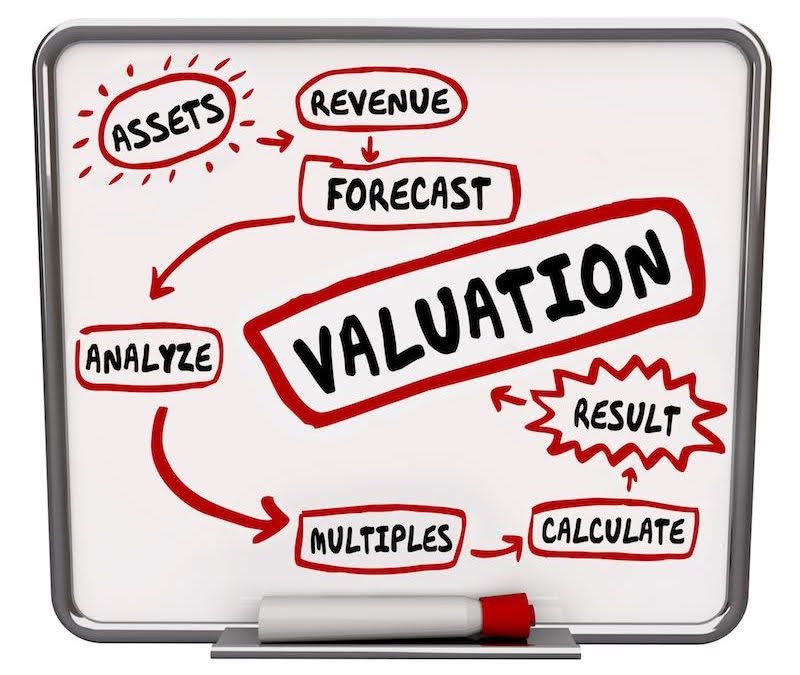
The process of business valuation includes the following key elements: choosing the right valuation method, gathering financial data, performing the valuation analysis, preparing the valuation report, and reviewing the report.

Before we define the business valuation process, we must first understand what the structure of the company is and benchmark it with comparable companies and only then can we choose the right valuation method to implement.
Here are the common methods of valuation used:
Income Approach
This approach evaluates the future profits of the company. Under this approach, the following methods are used:
Market Approach
Here, similar businesses that have been sold recently become the basis of valuation. Two different types of analysis can become the basis of the valuation such as:
Asset-Based Approach
This approach relies on the valuation based off of its Balance Sheet – the value of the assets or liabilities. These following methods are used:

Now that we have identified the different valuation approaches and methods that can be used, the real question now is, how does the business valuation process work?
One of the most critical aspects of selling your online business, whether it’s selling an Amazon FBA business or selling your website, is taking a good look at your financials. This step alone can tell you whether or not you’re on track.
Here, you need to prepare the following documents:
To get an accurate picture of the valuation, the documents – especially the financial statements – will need to be accurately recorded as well.
Aside from financial statement gathering, the seller also needs to prepare normalized earnings. Financial data is adjusted, and add-backs are applied. In other words, the following items need to be removed:
Basically, if the gains or losses don’t reflect the ongoing performance of the company, they need to be removed. Normalized earnings gives potential buyers what the financials truly look like operationally.
When you think about the meaning of business valuation process, especially in recent years, where small tech companies quickly rise solely because of the functionality of AI-integrated proprietary software, intangible assets need to be taken into account. The traditional approaches only took account of physical assets when computing the value of the company. This is not the case now.
Below outlines the reasons why intangible assets are important in the valuation:
Probably the key element in the business valuation process, more than the method and actual process, is having an understanding of the market and how it affects the business and its valuation.
The small business valuation process is no different from large corporations – both account for the status of the market and how it affects the valuation.
A similar company that recently sold becomes a basis for valuation of a business who uses the market approach. The growth rate of a business is dependent on how the market behaves for the industry the business belongs to. For example, a real estate business is highly dependent on the strength of the market.
The value of a business is closely tied to what’s happening in the broader market. Look at the current landscape, and you’ll see that the following aspects typically have an impact on a company’s worth:
Valuation professionals now look beyond financial statements. They weigh economic signals—GDP growth, unemployment rates, borrowing costs—alongside industry factors such as competitive pressures, shifting demand, and new regulations that can change the outlook overnight.
In volatile markets, stability can’t be assumed. In other words, a company’s past performance during turbulent times matters.

The valuation process in business does not stop with accounting for present and historical data. More importantly, the future outlook of the business is taken into consideration because it drives the growth potential of the business which means, potential for a higher net income.
Effects of the market condition in the business valuation includes the following:
These are just a few examples of how the growth potential of the business is affected by the market. Investors looking to diversify are more inclined to buy businesses that show promising growth potential. In other words, they will also look at metrics like customer retention, lifetime value, and operational scalability. Let’s take a SaaS company as an example. Potential buyers will likely find recurring revenue models attractive than companies that only accepting one-time payments for a software.

If you are disappointed when you discover the estimated value of your company, don’t give up hope. There is still the possibility that you could take some critical planning steps to enhance what is on the line for you and your business. The sooner that you talk to an online business broker and seek professional expertise, the easier it will be to figure out whether or not now is the right time for you to accomplish your underlying goals and how to best proceed with this process.
A business professional will be able to reach out to experts in valuing your business properly and reach out to a network of buyers to ensure that the whole process is executed with exceptional results.
What is business valuation process without an expert’s valuable input? So, schedule a consultation with Website Closers today to start your journey and get an accurate valuation of your business. We know how this process works from end to end and how to make it easier for you to accomplish your goals from the time of listing through the final sale.
Not always. Saying a business is worth “3 times profit” is an oversimplification.
Multiples vary depending on the following:
A business valuation can sometimes cost nothing at all if it’s included in the services of a business broker who charges a success fee upon the sale of your company.
For owners seeking a stand-alone valuation, the cheapest options typically start around $2,000 to $10,000 for small or straightforward businesses with clean financials.
When a company is bigger in size and its structure is more complex, costs rise.
Simply contact a business broker, CPA, or appraiser to get a professional business valuation. Do not do this on your own unless you’re a small business with predictable income.
Looking disorganized does not bode well for a prospective seller because the possible buyer might assume that this will be indicative of the overall experience of working with you. You need to be prepared in advance and should have the services of an experienced online business broker as soon as possible after you decide to list the company for sale.
This way you’ll know what to expect and can avoid common missteps that could slow down or block the sales process altogether. One key way to feel as prepared as possible for your business sale is to consider business valuation. When done right in the hands of experts, the transaction will run smoothly and deliver more than satisfactory results for all parties involved.
Not always. Saying a business is worth “3 times profit” is an oversimplification.
Multiples vary depending on the following:
A business valuation can sometimes cost nothing at all if it’s included in the services of a business broker who charges a success fee upon the sale of your company.
For owners seeking a stand-alone valuation, the cheapest options typically start around $2,000 to $10,000 for small or straightforward businesses with clean financials.
When a company is bigger in size and its structure is more complex, costs rise.
Simply contact a business broker, CPA, or appraiser to get a professional business valuation. Do not do this on your own unless you’re a small business with predictable income.


Thank you for your interest. We're happy to help in your acquisition search.
Please help us by providing an honest review. We focus on those that take the time to review our company.
Leave a Review