The best Flippa alternatives for established online businesses are Website Closers, Empire Flippers, Quiet Light, FE International, Acquire.com, Motion Invest, and Investors Club. For $1M+ businesses, a full-service broker such as Website Closers, Quiet Light, or FE International screens buyers and runs the deal. Empire Flippers and Acquire.com fit vetted mid-size sales, while Motion Invest and Investors Club suit smaller sites. Published seller fees range from 0% on Investors Club's standard listings to a $10,000 minimum commission at Empire Flippers (at the time of writing).
Picture a Shopify store owner clearing $350,000 a year in profit. She lists the business on Flippa, then spends 3 weeks answering questions from buyers she can't verify, sorting through low bids and wondering who will manage the transfer if a deal comes through. That's when many owners start looking at Flippa alternatives: sites that vet buyers before they see a listing, or brokers who handle the sale from valuation to closing.
Flippa works well for smaller deals. Established businesses, roughly $250,000 and up, tend to need more support: verified buyers, confidential marketing, and help with financing and due diligence. Here's a quick pick by deal size:
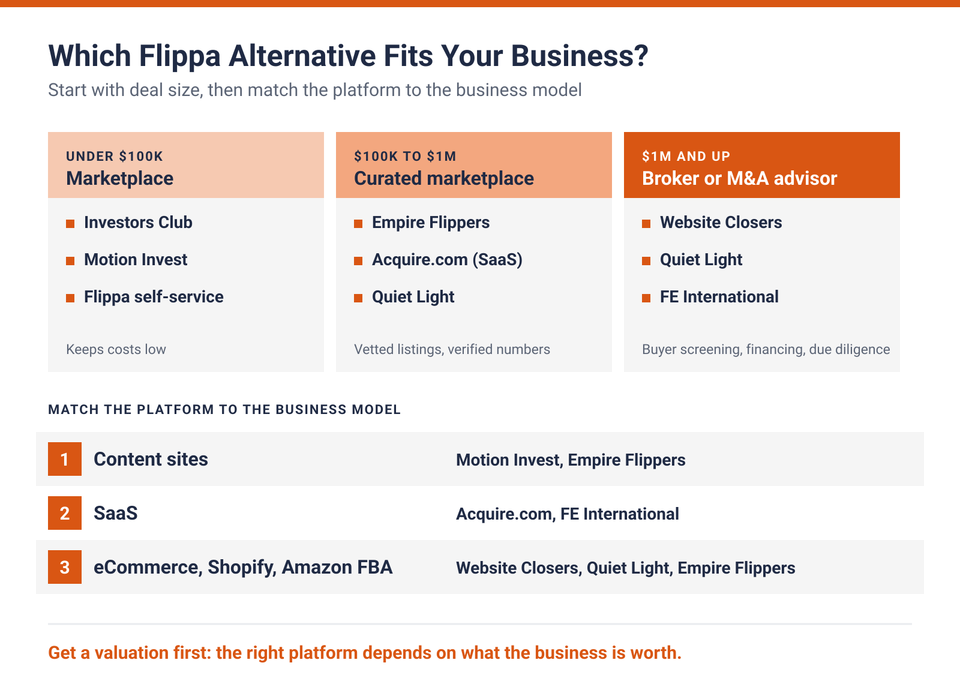
Under $100K: Investors Club for free standard listings, or Motion Invest for content sites and YouTube channels
$100K to $1M: Empire Flippers for vetted content and eCommerce businesses, or Acquire.com for SaaS
$1M and up: Website Closers for full-service brokerage, Quiet Light for owner-led advisory, or FE International for SaaS and tech M&A
Why Established Sellers Look Beyond Flippa
Established sellers move past Flippa mostly because an open marketplace leaves the sale work to the owner. That's manageable for a $20,000 blog. It gets harder when the business is worth $600,000 and the buyer needs an SBA loan.
Is Flippa legit? Yes, Flippa is a legitimate marketplace that offers escrow through Escrow.com and FlippaPay, and the company says 17,000 new buyers join every month. The catch for larger sellers is that much of the buyer screening falls on them.
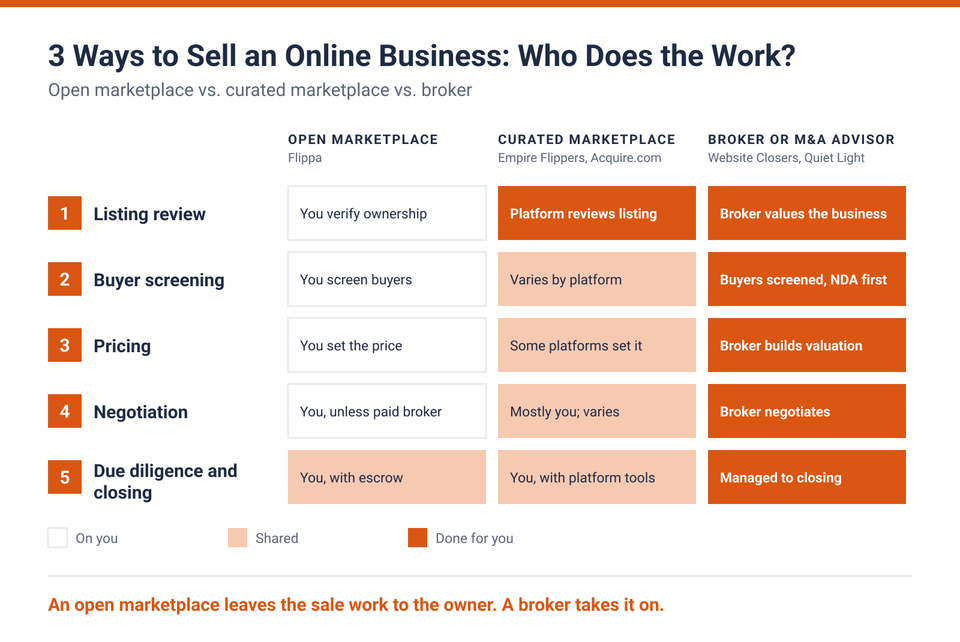
Online businesses usually sell through one of three models:
Open marketplace (Flippa): Almost anyone can list or bid, and the seller screens buyers and judges offers.
Curated marketplace (Empire Flippers, Acquire.com, Motion Invest, Investors Club): The platform reviews listings before they go live and often checks revenue.
Broker or M&A advisor (Website Closers, Quiet Light, FE International): A team values the business, markets it under NDA, negotiates and manages due diligence through closing.
Read almost any Flippa review from an owner with a larger business and the same issues come up: self-vetting eats time, open bidding draws tire-kickers, and scams are a risk wherever anyone can sign up. Negotiation and the handover also fall to the seller unless they pay for Flippa's broker service.
Flippa fees depend on the route. Self-service listings cover asking prices up to $100,000, start at $29 for 60 days and carry a 10% success fee. Broker packages start at $899 plus a 10% success fee, according to Flippa's pricing page (at the time of writing). For a side-by-side breakdown, see Website Closers vs Flippa.
Flippa Alternatives at a Glance
Flippa competitors fall into two groups: brokers that run the sale for you, and marketplaces where you run it yourself with more screening. Here's how seven websites like Flippa compare, based on each company's own site at the time of writing.
Platform
Model
Best for
Typical deal size
Seller fees
Vetting
Buyer network
Website Closers
Full-service broker
eCommerce, Amazon, SaaS and content exits
$500K to $500M, most $1M+
Success-based only; no upfront fees or retainers
NDA required; buyers screened for funds, financing and fit
1.3M+ buyers
Empire Flippers
Curated marketplace
Profitable content, eCommerce and FBA businesses
$2K+ monthly net profit minimum
No listing fee; blended 15% to 2.5% commission, $10K minimum
About 9% of submissions pass
$606M+ in total sales
Quiet Light
Broker
Amazon, eCommerce, content and SaaS owners
Five to eight-plus figures
Not published
Confidentiality agreement for every party
Not listed
FE International
M&A advisor
SaaS and tech companies
$1M to $100M focus
5%, 4% or 3% closing fee by asking price
In-house CPAs and CFAs prepare financials
80,000+ vetted investors
Acquire.com
Startup marketplace
SaaS founders selling direct
Under $250K to $1M+
8%, 7% or 6% closing fee plus $25 to $100 a month
Buyer vetting; Stripe and Google Analytics metrics
500K+ buyers
Motion Invest
Curated marketplace
Content sites and YouTube channels
Mostly small sites
$0 to list; 20% to 5% commission by price
Valuation review before listing
Not listed
Investors Club
Curated marketplace
Small sites and first-time sellers
About $1.7K to $75K on current listings
Free listing, 0% success fee; Full Service 5% to 20%
Manual review plus due diligence report
25,000+ buyers and sellers
Flippa (for reference)
Open marketplace
Small, simple sales
Self-service up to $100K asking price
From $29 listing plus 10%; broker from $899 plus 10%
Seller verifies ownership; buyer screening mostly on the seller
17,000 new buyers a month
Buyer network and sales figures are self-reported by each company.
The 7 Best Flippa Alternatives
These seven platforms are ranked for established sellers, starting with full-service online business brokers and ending with low-cost marketplaces for smaller sites.
1. Website Closers
Best for: Owners of eCommerce, Amazon, SaaS, content, and digital service businesses planning a $1M+ exit.
Deal size: $500K up to $500M, according to the firm's site.
Fee model: 100% success-based, with no upfront fees or retainers. The fee is set by deal size and structure.
Vetting: Buyers sign an NDA before seeing details and are screened for financial capacity, lending readiness, and operating fit.
In a Reddit thread on Flippa alternatives in r/buyingabusiness, one user described Website Closers as "the grown-up version of Flippa," pointing to structured deals, verified numbers, and real brokers handling negotiations. A broker builds the valuation, markets the business confidentially to a network of more than 1.3 million buyers, and manages talks through closing.
Website Closers also handles deal structure, including all-cash deals, seller financing, earnouts, and outside lenders such as SBA lenders and private equity. Most sales close within 30 to 120 days, the firm says.
Pros: Nothing is owed unless the business sells, marketing stays confidential, and the team supports financing and due diligence.
Cons: Commission rates aren't published, and the firm isn't set up for small starter sites.
2. Empire Flippers
Best for: Profitable content, eCommerce, Amazon FBA, and SaaS businesses with at least a year of clean records.
Deal size: At least $2,000 a month in net profit, averaged over the last 12 months.
Fee model: No listing fee. The commission is blended: 15% up to $700K, 8% on the portion between $700K and $5M, and 2.5% above $5M, with a $10,000 minimum.
Vetting: Empire Flippers says only 9% of submissions pass their vetting process.
Who does the checking is the main gap in any Flippa vs Empire Flippers comparison. Empire Flippers reviews revenue records, expenses and Google Analytics access before a listing goes live, then sets the price, typically 1.7x to 5x+ the last 12 months of net profit, based on their seller FAQ.
The trade-off is a two-month exclusivity period, after which you can stay listed or move on. For a closer look at a curated marketplace next to a full brokerage, read Empire Flippers vs Website Closers.
Pros: A published fee schedule, verified financials and no upfront cost.
Cons: The $10,000 minimum weighs on smaller deals, and the 15% rate covers the first $700K of a sale.
3. Quiet Light
Best for: Amazon, eCommerce, content, SaaS, agency and membership site owners who want an advisor who has run an online business.
Deal size: Five figures to eight-plus figures.
Fee model: Not published.
Vetting: Every party who works on a deal signs a confidentiality agreement before receiving business information.
Quiet Light's advisors have each bought, sold or started their own online businesses. The firm says it has helped more than 750 owners close over $500 million in combined transaction value. They also publish pricing results: 47% of listings sell at or above asking, the average listing draws two to three offers, and over 85% sell in 90 days or less.
Among website brokers, Quiet Light stands out for keeping sellers with the same advisor instead of handing them to a junior broker. Smaller deals usually take 30 to 60 days and larger ones 90 to 150, per their sell page. See how Quiet Light compares with other firms in our guide to the best M&A advisors for online businesses.
Pros: Advisors with operator experience, a wide deal range and published pricing results.
Cons: Fees aren't public, and sellers sign an exclusive engagement letter.
4. FE International
Best for: SaaS, eCommerce, content, and other tech businesses that need a full M&A process.
Deal size: FE International describes its focus as $1M to $100M deals.
Fee model: A single closing fee based on asking price: 5% under $250K, 4% from $250K to $1M, and 3% above $1M, per their seller pricing page.
Vetting: In-house CPAs and CFAs prepare the seller's financials, and buyers come from a network of more than 80,000 vetted investors.
Since 2010, FE International has completed more than 1,500 transactions and reports a 94.1% success rate on businesses taken to market. Their process looks closer to investment banking than a marketplace listing. The team writes a confidential information memorandum (CIM), positions the company for strategic acquirers and other buyers, and runs the deal to closing.
That depth suits a SaaS company with recurring revenue and several likely strategic buyers. It can be more process than a simple content site needs. See how FE International stacks up against other tech specialists in our list of the top SaaS M&A advisory firms.
Pros: Strong SaaS and tech focus, in-house financial prep and published closing fees.
Cons: The M&A process asks more of the seller's time than a marketplace listing, and the firm centers on tech businesses.
5. Acquire.com
Best for:SaaS and startup founders who want to sell directly to buyers.
Deal size: Fee tiers run from asking prices under $250K to over $1M.
Fee model: A monthly listing fee of $25, $50 or $100, plus a closing fee of 8%, 7% or 6% of the purchase price, paid only at sale.
Vetting: Buyer vetting, automated NDAs and live metrics from Stripe (through ChartMogul) and Google Analytics.
Acquire.com, formerly MicroAcquire, is the closest match for SaaS founders weighing Flippa vs Acquire. Acquire.com centers on startups, and sellers connect payment and traffic data so buyers see live numbers instead of screenshots. The company says it reaches more than 500,000 buyers and covers escrow at no cost to sellers.
Founders still handle most buyer conversations, with legal document builders and an assigned advisor in support. Profitable SaaS businesses with at least $100K in trailing revenue can apply for Guided by Acquire, a separate advisory service.
Pros: Clear published pricing, free escrow, and verified SaaS metrics.
Cons: A narrow startup focus, and the monthly fee runs until the business sells or the listing comes down.
Deal size: Mostly smaller sites. Their blog describes typical sites earning hundreds or thousands of dollars a month.
Fee model: Free to list. Commission slides from 20% under $20K to 15% ($20K to $50K), 10% ($50K to $100K), 7% ($100K to $500K), and 5% over $500K.
Vetting: Each site goes through a valuation review before listing.
Content is the whole focus at Motion Invest. Besides running a marketplace, the company has bought content sites directly from owners, which gives sellers a second route out.
For an established business, Motion Invest makes the most sense when the asset is a content site or channel rather than an eCommerce brand or SaaS product.
Pros: No listing fee, a content-site specialty, and a published commission scale.
Cons: A narrow focus, and 20% on small sales is steep.
7. Investors Club
Best for: Small content sites, Shopify stores, and first-time sellers watching costs.
Deal size: Small. Homepage listings ranged from about $1,700 to $75,000 at the time of writing.
Fee model: Standard listings are free with a 0% success fee. An optional Full Service tier charges a 5% to 20% success fee.
Vetting: Every listing is manually reviewed and comes with an independent due diligence report that flags data discrepancies by severity.
Keeping 100% of the sale price is the main draw on Investors Club's standard listings. There's no exclusivity, so sellers can list elsewhere at the same time. To qualify, a business needs at least one year of verifiable revenue and traffic history.
A seven-figure business will usually want more buyer screening and deal support than a free listing provides.
Pros: Free to list, no commission on standard listings and no lock-in.
Cons: A small typical deal size and limited hands-on help without the paid tier.
Marketplace or Broker: Which Is Right for Your Exit?
A marketplace fits smaller, simpler sales, and a broker fits larger or more complex ones. Owners who search "sell my website" or "where to sell my website" usually find marketplaces first, but the best place to sell a website depends on value, business type, and your time:
Set a realistic value first. Most online businesses are priced as a multiple of seller's discretionary earnings (SDE), so get a valuation before picking a platform.
Under $100K, start with a marketplace. Investors Club, Motion Invest or a Flippa self-service listing keeps costs low.
From $100K to $1M, look at curated options. Empire Flippers suits profitable content and eCommerce businesses, and Acquire.com suits SaaS. Quiet Light also works in this range.
At $1M and up, talk to a broker. Website Closers, Quiet Light, and FE International handle buyer screening, SBA loans, seller financing, earnouts, and due diligence.
Match the platform to the business model. Content sites fit Motion Invest and Empire Flippers. SaaS fits Acquire.com and FE International. eCommerce, Shopify and Amazon FBA brands fit Website Closers, Quiet Light and Empire Flippers.
Count the hours. A self-managed sale can mean weeks of buyer calls, document requests and negotiation on top of running the business.
Investors Club has the lowest published fees: free standard listings and a 0% success fee. For larger sales, it depends on how each fee is charged.
A listing fee is paid up front, sale or no sale. Flippa pricing follows this model for listings and broker packages, so those Flippa fees are owed even if the business doesn't sell. A success fee is paid only at closing, which is how Empire Flippers, Motion Invest, FE International and Website Closers charge. Acquire.com uses both.
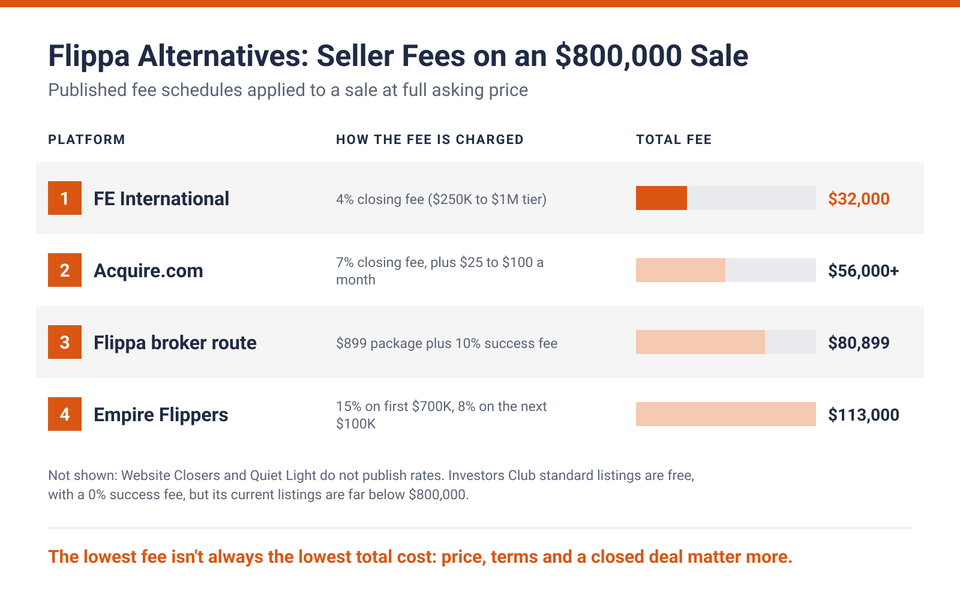
On published schedules (at the time of writing), an $800,000 sale at full asking price would cost $32,000 at FE International, $56,000 plus monthly listing fees at Acquire.com, $80,899 through Flippa's broker route and $113,000 at Empire Flippers.
The lowest fee isn't always the lowest total cost. A higher price, better terms or a buyer who actually closes can leave you with more after fees. For more on how commissions work, read broker fees explained.
Conclusion
Flippa does a good job with smaller, simpler sales. Once a business reaches the mid-six figures, most owners want vetted buyers, confidential marketing, and someone to manage financing and due diligence. Investors Club and Motion Invest serve smaller sites, Empire Flippers and Acquire.com cover the middle ground, and Website Closers, Quiet Light and FE International handle larger exits.
Whichever route you take, start with an accurate number. Run your figures through the Website Closers business valuation calculator for a quick estimate, then request a free, confidential valuation from a broker who can tell you what buyers will actually pay.
Doug Grindstaff is a seasoned M&A broker at Website Closers, specializing in helping sellers navigate the complex world of business exits. Based in Nashville, TN, Doug works with companies of all sizes across the globe, leveraging his extensive experience to…
What are the key differences between Empire Flippers and Flippa?
Flippa is an open marketplace where sellers set their price, screen buyers and negotiate themselves. Empire Flippers vets each business, sets the asking price and negotiates for the seller. Flippa charges listing fees plus a 10% success fee, while Empire Flippers has no listing fee and a blended commission from 15%, with a $10,000 minimum.
How reliable is Flippa for selling an established business?
Flippa is legitimate and offers escrow, so it can work for a larger sale. Self-service listings stop at a $100,000 asking price, so bigger sellers use broker packages starting at $899 plus a 10% success fee. Many owners of $1M+ businesses still prefer a dedicated broker for confidential marketing and deal support.
What is the best website to sell a website?
It depends on size and type. Investors Club and Motion Invest suit smaller content sites, Empire Flippers fits sites earning $2,000+ a month, and Acquire.com fits SaaS. For $1M+ businesses, a broker such as Website Closers, Quiet Light or FE International offers more buyer screening and deal support.
Which website-selling platform has the lowest fees?
Investors Club has the lowest published fees, with free standard listings and a 0% success fee. FE International lists closing fees of 3% to 5%, Acquire.com charges 6% to 8% plus a monthly listing fee, and Motion Invest's commission runs from 20% down to 5% (at the time of writing).
Is a broker better than a marketplace for a $1M+ online business?
For most $1M+ businesses, yes. A broker values the business, markets it confidentially, screens buyers and manages financing, earnouts, and due diligence, work a marketplace leaves to the seller. Website Closers, for example, charges no upfront fees or retainers, so the seller pays only when the deal closes.
Can I list on Flippa and another platform at the same time?
Sometimes. Investors Club asks for no exclusivity, so you can list there and elsewhere. Empire Flippers asks for at least two months of exclusivity, and Quiet Light works under an exclusive engagement letter. Read each agreement first, and keep your price and numbers consistent everywhere so buyers don't lose trust.
Did you know that Website Closers has one of the largest databases of listings sold on the East Coast, especially eCommerce and Tech businesses, and a lot more? Flippa is somewhat popular, yes, but Website Closers has a larger database of listings. Imagine you own a vintage 1967 Mustang and you’ve spent 5 years restoring…
In recent times, there has been an increase in the buying and selling of digital assets. Buying or selling a business isn’t just about posting about the sales; there are mountains of paperwork and financial records to be done. When it comes to selling your business assets this year, you’re most likely faced with two…
Exiting online businesses present unique considerations not faced when selling traditional business operations. Digital businesses involve speedier transactions, larger international buyer audiences, and complex digital technology, ranging from product supply chains and platform compliance to paid advertising accounts and Google searches. Efforts to facilitate a sale without assistance from an intermediary who appreciates the nuances…
8 min readRead more
Want to Sell Your Business Now? Get a Free Consultation!
A broker calls you back, usually within 1–2 hours
Confidential: nothing is shared without your consent