Buying an online business is often the fastest way to transition into the internet sector, because you start with customers, revenue and a working sales channel instead of an idea. The harder part is choosing which kind of online business fits your budget, skills and lifestyle, and then verifying that the one you buy is as healthy as it looks.
Key Takeaways
Buying an established online business usually beats starting from zero if you have capital but limited time, because you inherit proven demand and cash flow.
The main models (Amazon FBA, your own ecommerce store, multichannel, SaaS and content sites) differ sharply in fees, control, workload and risk.
Amazon brings traffic and trust but takes a referral fee on every sale (15% in most categories) and controls the rules; your own store keeps the margin but forces you to buy traffic.
Before you shop for listings, answer four questions honestly: how soon you need income, which market suits you, where the market is heading and how competitive it is.
Verify every claim in due diligence, and budget for working capital and transition costs on top of the purchase price.
Why the Internet Sector Is a Realistic Place to Land
The internet is no longer an experiment. Payment rails, logistics networks, cloud software and marketplaces are mature, and online shopping is part of everyday life for most consumers. That maturity is exactly why the internet sector attracts career changers, corporate professionals and brick-and-mortar owners who want a business they can run with more flexibility.
It also means you can buy a business with a track record. Instead of guessing whether a product will sell, you can review years of sales data, traffic analytics, customer reviews and supplier history before you commit. For many first-time buyers, that visibility is worth more than the savings of building something themselves. If you are still weighing the trade-offs, our breakdown of the pros and cons of buying an existing business is a good starting point.
Buy or Start? How the Two Paths Compare
Starting from scratch costs less up front, but you pay with time and uncertainty. Buying costs more on day one, but you get revenue from the first month. The table below summarizes the trade-off most buyers face.
Factor
Buying an established online business
Starting a new online business
Upfront cost
Purchase price plus working capital
Lower: product, website, marketing tests
Time to income
Immediate, if the business is profitable
Often many months, sometimes years
Risk
Lower, because demand is proven, but you inherit problems
Higher: most of the risk is product and market fit
Data to judge it
Financials, traffic, customer and supplier history
Projections and assumptions only
Financing
Seller financing and SBA loans are available
Hard to finance before revenue exists
Learning curve
Steep but guided by the seller's transition
Self-taught through trial and error
If you need income within months, buying is usually the more realistic path. If you have more time than capital, starting small and growing can make sense, and our guide to online business models to consider before launching covers that route.
Choosing Your Model: Amazon, Your Own Store or Both
When people think about moving into the internet sector, they usually picture an ecommerce storefront. Online stores are common, but they are only one option. Many profitable companies sell mainly through Amazon or other marketplaces and do very little business on their own website, while others run software or content businesses with no physical products at all.
Selling on Amazon
Amazon FBA businesses plug into enormous built-in traffic and customer trust. Amazon handles storage, shipping and much of customer service. That convenience has a price: a Professional selling plan costs $39.99 a month, and Amazon charges a referral fee on every sale, 15% in most categories, plus fulfillment fees. You also operate under Amazon's rules, so a policy change, a listing suspension or a new competitor can hit revenue quickly.
Running your own ecommerce store
An independent ecommerce business pays no marketplace commission and owns its customer list, which buyers value. The trade-off is traffic: you have to earn or buy every visitor through SEO, paid ads, email marketing and social channels. Rising ad costs can squeeze margins if the store depends on a single paid channel.
Selling across multiple channels
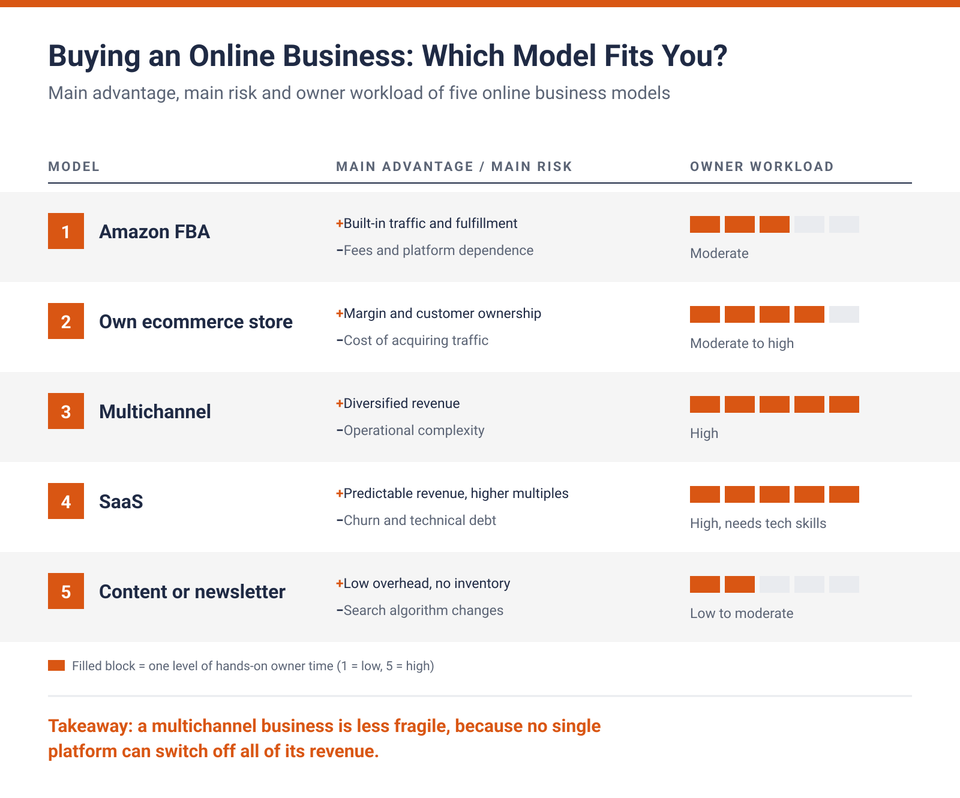
Many of the strongest businesses combine both: Amazon for reach, a direct store for margin and customer data, and sometimes wholesale or other marketplaces. A multichannel business is less fragile, because no single platform can switch off all of its revenue. The catch is complexity, since inventory, pricing and advertising must be managed across every channel.
Software and content businesses
SaaS businesses sell subscriptions and tend to command higher valuations because recurring revenue is predictable. Content sites and newsletters earn from advertising and affiliate commissions. Both avoid inventory, but they require different skills: product development and churn management for SaaS, and search traffic and audience growth for content.
Model
How it earns
Main advantage
Main risk
Hands-on workload
Amazon FBA
Product sales on Amazon
Built-in traffic and fulfillment
Fees and platform dependence
Moderate
Own ecommerce store
Product sales on your website
Margin and customer ownership
Cost of acquiring traffic
Moderate to high
Multichannel
Amazon, own store, wholesale
Diversified revenue
Operational complexity
High
SaaS
Recurring subscriptions
Predictable revenue, higher multiples
Churn and technical debt
High, needs tech skills
Content or newsletter
Ads, affiliates, sponsorships
Low overhead, no inventory
Search algorithm changes
Low to moderate
Four Questions to Answer Before You Shop
An experienced broker will ask you these questions before showing you a single listing. Answering them first saves weeks of looking at businesses that were never a fit.
Do you need cash flow immediately? If you are replacing a salary, focus on businesses with stable, verified owner earnings. If you can put a salary on the back burner, a business with growth upside but thinner current profit may be a better buy.
Which market suits your lifestyle, personality and budget? A supplement brand, a B2B software tool and a hobby content site demand very different days. Pick a market you understand or are willing to learn deeply.
Where is the market heading? Look at search demand, category growth and platform changes over the past few years. A business riding a fading trend is cheap for a reason.
How competitive is the niche? Crowded categories with low barriers to entry mean constant price pressure. A defensible brand, exclusive supplier terms or loyal subscribers are worth paying for.
Set your criteria and budget. Define the model, size, niche and price range you are targeting, and decide how much cash you can commit after keeping reserves.
Line up financing early. Options include cash, seller financing, earnouts and SBA loans. SBA 7(a) loans go up to $5 million and typically require a buyer equity injection of around 10% on a change-of-ownership deal. Learn more in our article on using an SBA loan to buy a business and on our deal financing page.
Find and screen listings. Browse vetted businesses for sale, sign NDAs and request the offering memorandum. Discard anything with unexplained revenue swings or vague financials.
Analyze value. Compare asking price to seller's discretionary earnings or EBITDA and to recent comparable sales. As a directional guide, Acquire.com's August 2026 State of the Deal data put ecommerce at roughly 2x to 4x profit and SaaS at roughly 3x to 5x profit, with quality and size moving deals within or beyond those ranges.
Submit a letter of intent. Outline price, structure, exclusivity period and key conditions.
Run due diligence. Verify revenue in the payment processor and marketplace dashboards, review traffic sources, supplier contracts, inventory, customer concentration and any account health warnings. Our guide on how to evaluate a business before buying lists what to check.
Close and transition. Sign the purchase agreement, transfer domains, accounts and inventory, and use the seller's training period to learn the operation.
Common Mistakes First-Time Online Buyers Make
Buying on revenue instead of profit. A store doing $2 million in sales with 4% margins may be worth less than a smaller, more efficient one.
Ignoring platform risk. A business that gets 90% of sales from one Amazon listing or one Google ranking can lose value overnight.
Underfunding working capital. Inventory reorders, ad spend and software subscriptions continue from day one.
Skipping independent verification. Screenshots can be edited. Ask for read-only access to the actual accounts.
Overestimating your available time. Many "passive" online businesses still need real weekly owner time, especially during the transition.
Knowing these traps in advance is half the work of avoiding them.
Why Work With an Experienced Broker
A broker who specializes in internet businesses has seen how Amazon accounts, ecommerce stores and SaaS companies behave after a sale, and which red flags tend to surface late. A good broker helps you compare models, screens out weak listings, structures financing and keeps due diligence moving. If you are new to acquisitions, our tips on working with a business broker as a buyer explain what to expect.
Ready to Make the Move?
Transitioning into the internet sector is no longer a gamble, but it does reward preparation. Decide which model fits your goals, answer the four key questions honestly, secure financing and verify everything before you sign. When you are ready, talk with one of our experienced brokers about the kind of business you want to own, or browse the listings we represent today.
Ron has over two decades of experience in buying and selling online companies. He is a pioneer in the industry and for several years was affiliated with the largest business brokerage in the world. Consistently in the Top 10 brokers…
Buying an online business can be a good idea if you have capital but limited time, because you get customers, revenue and a proven sales channel from day one. It works best when you verify the financials independently, understand the platform risks and choose a model that matches your skills. A rushed purchase without due diligence is where most buyers lose money.
How much does it cost to buy an online business?
Prices range from a few thousand dollars for small side projects to millions for established brands. Most online businesses are priced as a multiple of annual profit, and the multiple depends on the model, growth, risk and size. Budget for working capital, inventory, legal fees and transition costs on top of the purchase price.
Should I sell on Amazon or build my own ecommerce store?
Amazon gives you built-in traffic and fulfillment but charges a referral fee on every sale, 15% in most categories, and controls the rules. Your own store keeps the margin and the customer list but requires you to buy or earn traffic. Many strong businesses use both, which reduces dependence on any single platform.
Can I finance the purchase of an online business?
Yes. Common options include seller financing, earnouts and SBA 7(a) loans, which go up to $5 million and typically require a buyer equity injection of around 10% on a change-of-ownership deal. Lenders look for verified cash flow, so businesses with clean financials and tax returns are much easier to finance.
Is it better to buy or start an online business?
Buying is usually better if you need income soon and have the capital, because the demand is already proven. Starting is cheaper up front but can take many months or years to reach steady profit. Your budget, timeline and tolerance for uncertainty should decide which path fits you.
Buying an existing business offers benefits like immediate cash flow, an existing customer base, and simpler capital access, but also drawbacks like high initial costs and potential for inheriting problems like hidden debt or negative worker morale. Although you get a head start with established procedures and suppliers, you can be stymied by established systems…
Understanding the stages of business buying process is essential for any buyer looking to make a successful acquisition. If you’re buying your first business or expanding your portfolio, taking things one step at a time can help lower your risk, make it easier to make decisions, and make the transition to ownership go more smoothly.…
Valuing a business to buy is one of the most important steps you’ll take before making a purchase. Whether you want to free yourself from the corporate grind by handling a business or expand by acquiring a competitor, understanding how to evaluate a business properly prevents you from overpaying. From analyzing seller’s discretionary earnings to…
7 min readRead more
Want to Sell Your Business Now? Get a Free Consultation!
A broker calls you back, usually within 1–2 hours
Confidential: nothing is shared without your consent