


What Are the Three Main Categories of Website Buyers Today?
Website buyers fall into three groups: individuals, financial buyers and strategic acquirers. Learn what each wants, how they pay and how to attract them.
8 min read


Quick Summary via AI:
Finding the right buyer for your online business means finding someone who is funded, capable of running what you built, aligned with your deal terms and trustworthy with your data. Interest is easy to get once a listing goes live. Qualified buyers are the scarce part, and the way you screen and stage information decides whether you spend months with tire kickers or close with someone who can actually pay.
Selling a website, ecommerce store or SaaS company is different from selling a storefront. The buyer can't walk the floor, so they rely almost entirely on your data: traffic sources, ad accounts, supplier terms, conversion rates and churn. That same data is exactly what a competitor would love to see. So the right buyer has to clear two bars at once: they must be able to close, and they must be safe to open the books to.
In practice, a right-fit buyer for an online business usually checks four boxes:
Buyer type matters too. Individual operators, financial buyers and strategic acquirers value businesses differently, as covered in our guide to the three main categories of website buyers and the comparison of strategic vs. financial buyers.
An unqualified buyer rarely just disappears. More often they drag the process out and leave damage behind:
Most inquiries on a public listing won't turn into offers. The goal isn't to be suspicious of everyone, but to recognize patterns early and make each buyer earn the next level of access.
Buyer type | Warning signs | How to filter |
|---|---|---|
Tire kicker | Vague about acquisition criteria, no timeline, asks for everything at once, never names a price range | Require a buyer profile and a call before any financials are shared |
Unfunded dreamer | Can't say how they'll pay, plans to "figure out financing later," avoids proof of funds | Ask for bank statements, a lender pre-qualification or a fund commitment before detailed data |
Information fisher | Works in your niche, skips valuation questions, focuses on suppliers, keywords and ad accounts | Strict NDA, staged disclosure, redact supplier and customer names until after LOI |
Lowballer who retrades | High headline offer, short diligence promise, insists on long exclusivity, little cash at close | Check deal history, prefer offers with more cash at close and tight exclusivity windows |
Absentee optimist | No operating experience, no team, assumes the business runs itself | Ask for a 90-day post-close plan and who will handle daily operations |
These categories overlap, and a first-time buyer isn't automatically a bad buyer. Plenty of first-time buyers are well funded and well advised. What separates them is whether they can answer specific questions and back up their claims.
Buyer qualification works best as a sequence where each step unlocks the next. Here is the process we recommend for online businesses:
If you want a longer list of screening questions, our guide on how to screen potential business buyers goes further into interviewing techniques.
Asking for proof of funds is standard in business sales, and a serious buyer expects it. Acceptable evidence usually includes:
Keep in mind how financed deals are structured. SBA 7(a) loans go up to $5 million, and a buyer in a full change-of-ownership deal generally needs to inject equity of at least 10% of the project cost. A buyer who can't show that injection isn't ready yet. Our deal financing page explains how SBA loans and seller financing fit together.
The single most effective way to protect yourself from information fishers is to match what you reveal to what the buyer has proven. Everything else in the qualification process supports this.
Stage | What the buyer has provided | What you share |
|---|---|---|
Teaser | Initial inquiry only | Business model, category, revenue and SDE ranges, growth highlights, no name or URL |
NDA signed | Signed NDA and buyer profile | Business name, URL, summary P&L, traffic overview, reason for selling |
Funds verified | Proof of funds or lender pre-qualification, discovery call | Confidential information memorandum, monthly P&Ls, traffic and channel breakdown, high-level supplier and customer mix |
LOI signed | Signed LOI with price, structure and exclusivity | Data room, tax returns, bank statements, contracts, named suppliers, read-only analytics and ad account access |
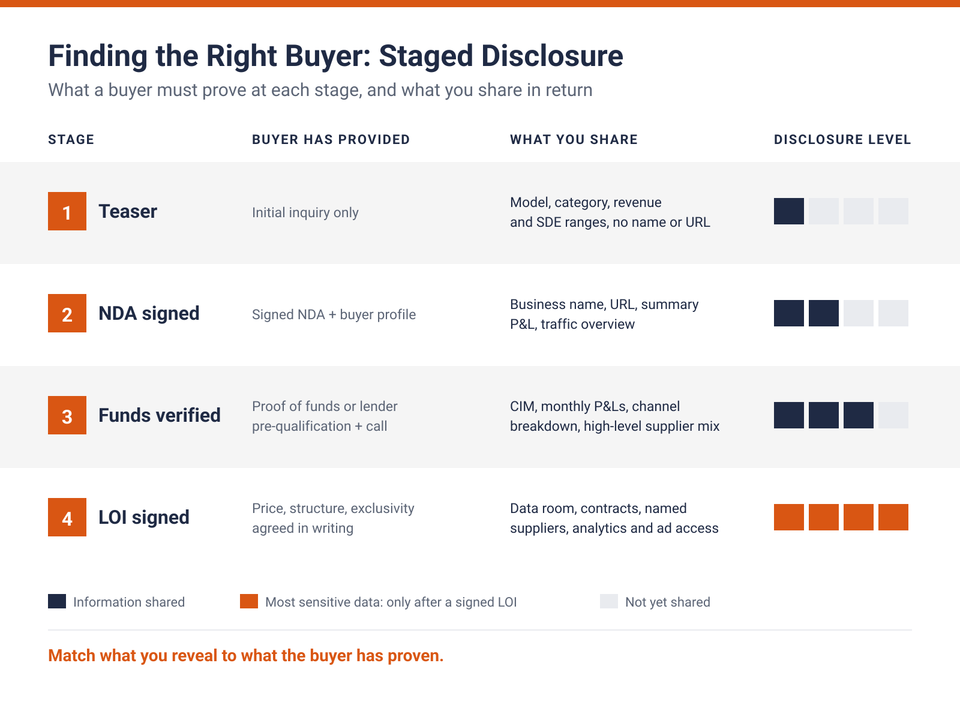
The most sensitive items should come last: supplier identities and terms, customer lists, keyword and content strategy, and ad account access. Those are the assets a competitor can copy, and a genuine buyer won't need them to decide whether to make an offer.
Qualifying buyers is easier when you start with a better pool. Public marketplaces bring volume, but much of it is aspirational. Stronger sources include:
We cover the channels in more detail in how to find a buyer for your business. If you're weighing whether to run the search yourself, read our breakdown of selling on your own vs. using a broker.
The right questions sort buyers quickly. Listen for specific, consistent answers:
Expect the buyer to ask hard questions of you too. A buyer who asks nothing about risk, margins or customer concentration is often not serious. Our list of questions sellers should expect from website buyers helps you prepare.
The right buyer is funded, capable, aligned on terms and careful with your information. You find them by marketing anonymously, qualifying each buyer step by step and releasing data only as they prove they're serious. That approach protects your business while it's on the market and keeps your strongest negotiating position intact.
Website Closers works with an active network of pre-qualified buyers for online businesses of every size, from content sites to ecommerce brands and SaaS companies. If you're thinking about an exit, start a confidential conversation about selling your business or see how our process works.
A tire kicker is someone who shows interest in buying your business but has no real intention or ability to complete the purchase. They ask for information, schedule calls and sometimes request financials, then never make an offer. In online business sales, the fastest way to filter them is to require a buyer profile, a signed NDA and proof of funds before you share detailed data.
Serious buyers can explain what they want to acquire and why, show how they will fund the deal, and give consistent answers about timeline and who will run the business after closing. They also ask pointed questions about risk, margins and customer concentration. Hesitation to provide proof of funds or sign an NDA is usually a sign the buyer is not ready.
Yes. Asking for proof of funds before you release detailed financials is standard practice and protects your time and confidential data. Acceptable evidence includes recent bank or brokerage statements, a lender pre-qualification letter for an SBA loan, or a commitment letter from a fund or investor. Summary figures can come earlier, but monthly P&Ls and channel data should wait.
Before an NDA, share only an anonymous teaser: the business model, a general niche category, revenue and SDE ranges and the growth story. Leave out the business name, URL, supplier names and anything that would let a buyer identify the business. Once the NDA is signed, you can reveal the name, URL and summary financials.
The most reliable route is a broker with an established network of buyers who have already completed acquisitions and verified their funds. Other channels include strategic acquirers in adjacent niches, private equity firms and search funds, and public marketplaces, which bring volume but more unqualified interest. Whatever the source, every buyer should go through the same qualification steps.
Website buyers fall into three groups: individuals, financial buyers and strategic acquirers. Learn what each wants, how they pay and how to attract them.

Learn the questions buyers ask when buying a business, from why you're selling to earnings and traffic, and how sellers should prepare clear answers.

Should you sell your online business yourself or use a broker? Compare costs, risks and net proceeds, then use a 5-step framework to choose your route.

Prefer to talk?
800-251-1559