Quick answer: SDE adds the full pay and perks of one owner back to profit. EBITDA (in its adjusted form) assumes the owner is replaced by a manager paid a market salary. Most businesses earning under about $1 million are valued on SDE, and most earning above $1.5 million to $2 million are valued on adjusted EBITDA. Individual and SBA-backed buyers think in SDE, while private equity firms and strategic acquirers think in adjusted EBITDA.
The SDE vs EBITDA question sounds like accounting trivia until a buyer puts a price on your company. Then it becomes one of the biggest levers in the deal.
The same business can show $458,000 of earnings on one line and $348,000 on another. Both numbers can be correct. What changes is the question each metric answers. SDE asks how much cash one owner-operator takes out of the business. EBITDA asks how much the business earns once someone else is running it.
Pick the wrong metric, or pair it with the wrong multiple, and you'll anchor on a price no buyer in your market will pay. Below, we cover the formulas, run one sample P&L both ways, and explain which buyers use which number. You'll also see why the EBITDA vs SDE debate matters less than matching the multiple to the metric.
What Is SDE (Seller's Discretionary Earnings)?
If you're asking what is SDE in business, here's the short version. Seller's discretionary earnings is the total financial benefit one full-time owner gets from the business in a year. You'll also hear it called owner's discretionary earnings or owner benefit. The SDE meaning in business is practical: it shows a buyer who plans to run the company how much they could pay themselves, use to cover a loan, and keep as profit.
The International Business Brokers Association (IBBA) definition, as quoted by Morgan & Westfield, starts with net income and adds back:
Interest
Taxes
Depreciation and amortization (D&A)
Non-recurring expenses, such as a one-time legal fee or a site rebuild
Non-operating items, meaning income or costs not tied to the core business
Total compensation for one owner, including salary, payroll taxes, benefits and personal perks run through the company
If more than one owner works in the business, only one gets added back in full. The others are adjusted to what a hired employee would cost for the same role.
The basic SDE formula looks like this:
SDE = Net income + interest + taxes + D&A + non-recurring items + non-operating items + one owner's total compensation
That's as far as we'll go on the mechanics here. For a full walk-through of seller discretionary earnings and how multiples are applied to them, see our dedicated guide.
What Is EBITDA and Adjusted EBITDA?
EBITDA stands for Earnings Before Interest, Taxes, Depreciation and Amortization. It strips out financing choices, tax situations and non-cash accounting charges so buyers can compare operating profit across companies. If you want the plain-English basics first, our article on EBITDA meaning covers it.
Raw EBITDA comes straight off the P&L. It doesn't adjust anything else, and that creates a problem for owner-run companies. Owner pay is often set by tax strategy, not by the job. One owner pays herself $40,000 and takes the rest as distributions. Another pays himself $300,000. Neither number tells a buyer what it really costs to run the business.
Adjusted EBITDA fixes this. It starts with EBITDA, adds back the same one-time and non-operating items that SDE does, and then normalizes owner pay. Instead of adding the owner's salary back in full, the buyer replaces it with a market-rate manager salary. That's what they'd pay a hired general manager to do the owner's job, including payroll taxes and benefits.
The logic is simple. A private equity firm or a corporate buyer isn't going to run your business day to day. They'll hire someone. Adjusted EBITDA shows the profit left after that person gets paid. It's the number you'll see in a quality of earnings report and in most lower middle market deals.
SDE vs EBITDA: Key Differences
The difference between SDE and EBITDA comes down mostly to one line: owner compensation. Nearly every other adjustment overlaps. Here's how seller's discretionary earnings vs EBITDA compare side by side.
Adjustment
SDE
EBITDA
Adjusted EBITDA
Starting point
Net income
Net income
Net income
Interest
Added back
Added back
Added back
Taxes
Added back
Added back
Added back
Depreciation and amortization
Added back
Added back
Added back
Owner salary and benefits
One owner added back in full
Left as expensed
Replaced with market-rate salary
Owner perks
Added back
Not added back
Added back
Non-recurring expenses
Added back
Not added back
Added back
Non-operating items
Added back
Not added back
Added back
Who runs the business
The owner
Not considered
A hired manager
Typical user
Individual and SBA buyers
Lenders and quick comparisons
Private equity and strategic buyers
Because SDE includes the owner's full pay, it's almost always higher than adjusted EBITDA for the same company. The gap roughly equals the cost of a replacement manager. In a business where the owner handles sales, operations and hiring, that gap can easily reach $100,000 to $200,000.
There are two things neither metric captures: capex and working capital. If a business must spend $80,000 a year on equipment just to keep running, it doesn't really throw off its full SDE or EBITDA as free cash. The same goes for an e-commerce brand that ties up cash in inventory. Experienced buyers look past both metrics to these items before they settle on a price.
Worked Example: One Business, Two Numbers
Here's how to calculate SDE and adjusted EBITDA from the same P&L. Take a hypothetical e-commerce brand with $2.4 million in revenue and one owner who works full time.
P&L line item
Amount
Revenue
$2,400,000
Cost of goods sold
$1,080,000
Gross profit
$1,320,000
Owner salary
$150,000
Owner perks (car, health insurance, personal travel)
$18,000
Staff and contractors
$420,000
Ad spend
$310,000
Software and platform fees
$72,000
Rent and other overhead
$60,000
One-time website rebuild
$40,000
Depreciation and amortization
$25,000
Interest
$15,000
Pre-tax income
$210,000
Taxes
$45,000
Net income
$165,000
Now the SDE calculation and the adjusted EBITDA calculation, using the same starting point:
Item
SDE
Adjusted EBITDA
Net income
$165,000
$165,000
Plus taxes
$45,000
$45,000
Plus interest
$15,000
$15,000
Plus D&A
$25,000
$25,000
Plus one-time rebuild
$40,000
$40,000
Plus owner perks
$18,000
$18,000
Plus owner salary
$150,000
$150,000
Less market-rate manager salary
$0
($110,000)
Total
$458,000
$348,000
For reference, plain EBITDA with no adjustments would be $250,000 (net income plus interest, taxes and D&A).
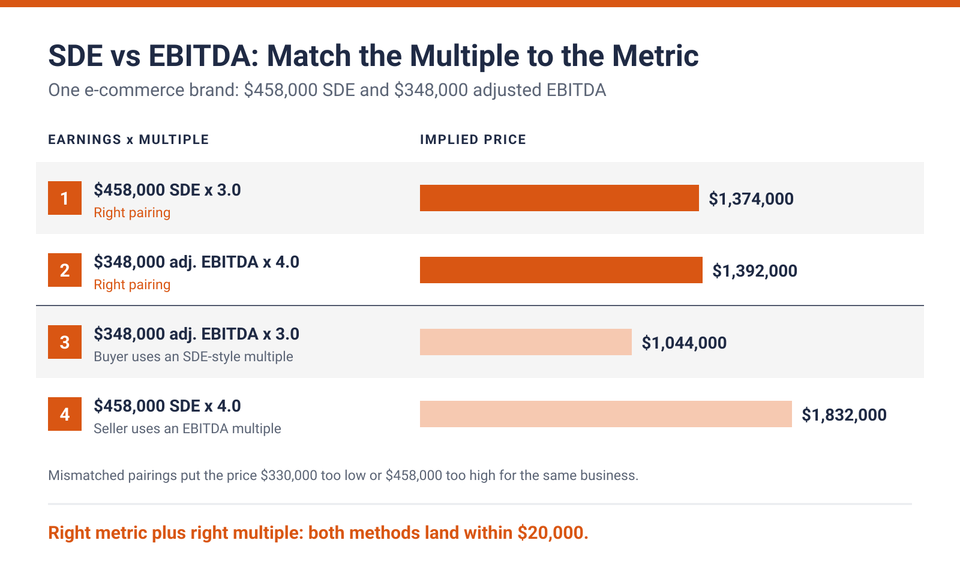
So SDE lands at $458,000 and adjusted EBITDA at $348,000. Now apply typical multiples. We'll use 3.0x for SDE and 4.0x for adjusted EBITDA. These are for illustration only, since real multiples depend on industry, growth and risk.
SDE valuation: $458,000 x 3.0 = $1,374,000
Adjusted EBITDA valuation: $348,000 x 4.0 = $1,392,000
The two values land within $20,000 of each other. That's the main lesson. When the right multiple goes with the right metric, the results tend to meet in the middle. Marketplaces like BizBuySell report SDE as cash flow, which confuses many sellers. In any cash flow SDE vs EBITDA comparison, the gap in earnings mostly disappears once the multiple reflects who is buying.
What Happens If a Buyer Switches Metrics
Trouble starts when metrics and multiples get mixed. Using the same business:
A seller lists at 3.0x SDE and asks $1.37 million. That's a fair, defensible ask.
A private equity buyer recasts the books, lands on $348,000 of adjusted EBITDA and applies a 4.0x multiple. The offer comes in near $1.39 million, so the deal holds together.
Now picture a buyer who applies the 3.0x SDE-style multiple to adjusted EBITDA. The offer drops to $1,044,000, which is $330,000 less for the exact same business.
The mistake runs the other way too. A seller who applies a 4.0x EBITDA multiple to SDE asks $1,832,000. No informed buyer will pay that, and the listing goes stale.
When you get an offer, always ask which earnings figure the buyer used and what multiple they applied to it.
Which Metric Will Buyers Use?
So what is SDE in business valuation, in practice? It's the earnings base an owner-operator buyer multiplies to reach a price. Adjusted EBITDA plays the same role for buyers who will hire management. Which one applies to you depends on three things.
By Earnings Size
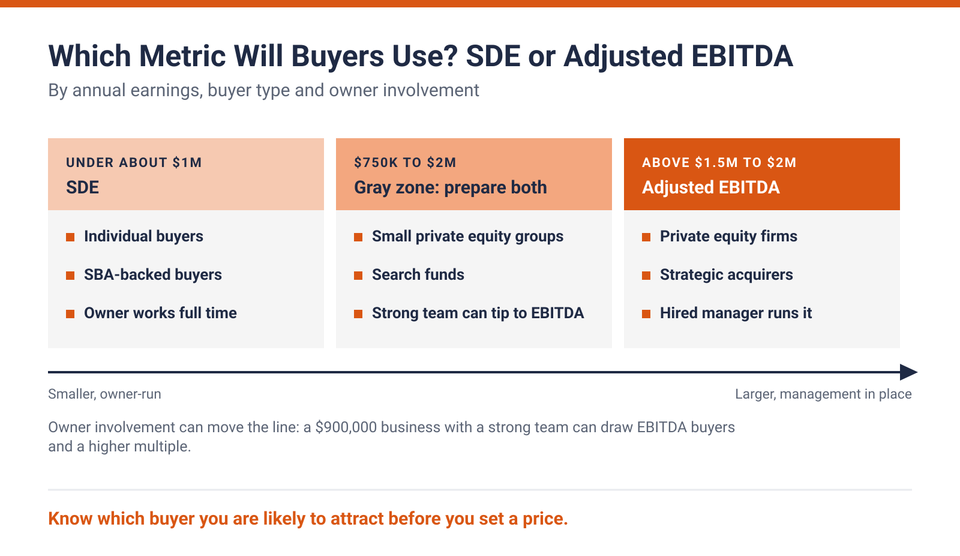
Morgan & Westfield says SDE is normally used for businesses with less than $1 million in SDE, while EBITDA is used for mid-sized companies with more than $1 million in EBITDA. MidStreet drew a similar line in a 2021 article (now a few years old): most businesses under $1 million in earnings are valued on SDE, and those at $1.5 million or more on EBITDA.
For scale, BizBuySell's Q1 2026 report puts the median cash flow (SDE) of sold businesses at $165,256 and the median sale price at $350,000. Most main street deals sit firmly in SDE territory.
Between roughly $750,000 and $2 million in earnings, there's a gray zone. Here you might attract both an individual buyer and a small private equity group. If you're in this range, prepare both numbers before you go to market.
By Buyer Type
Individual buyers usually plan to replace you. They look at SDE because it shows what they'll have to live on and repay debt with. Most use an SBA loan, and the lender checks debt service coverage: whether SDE, minus a reasonable salary for the new owner, covers the loan payments with room to spare.
Search fund buyers often sit in the gray zone. They step in as CEO themselves but answer to investors, so many underwrite on adjusted EBITDA.
Private equity firms and strategic acquirers use adjusted EBITDA almost every time. They'll keep or hire a management team, and they compare targets to deals priced on EBITDA multiples and enterprise value. If you want a wider view of who might buy, read our guide to buyer types beyond private equity.
By Owner Involvement
Size isn't everything. Owner dependence matters just as much. If you work 60 hours a week and hold every key client relationship, buyers will see your company as a job that comes with a business, and SDE fits. If a general manager already runs operations and you put in 10 hours a week, an EBITDA view can make sense even below $1 million in earnings. A $900,000 business with a strong team can draw EBITDA buyers and a higher multiple.
SDE Multiples vs EBITDA Multiples
EBITDA multiples are higher than SDE multiples, and sellers sometimes read that as a free upgrade. It isn't. There are four reasons for the gap:
The earnings base is smaller. A manager's salary is already taken out of adjusted EBITDA, so the multiple has to be higher to reach a similar price.
The businesses are bigger. Companies valued on EBITDA tend to have more revenue, more customers and more staff, which lowers risk.
Owner dependence is lower. A business that runs without its founder is easier to transfer, so buyers pay more for each dollar of profit.
The buyer pool is deeper. Institutional buyers with committed capital compete for these deals.
On the main street side, the BizBuySell medians above suggest a price of about 2.1 times SDE. An SDE multiple in the 2x to 4x range is common for small owner-run companies, while EBITDA multiples typically start higher and climb with size and growth. As the worked example showed, a 3.0x SDE multiple and a 4.0x EBITDA multiple can describe nearly the same price.
There's a common complaint on forums like Reddit that brokers inflate SDE to justify higher prices. The concern is fair. Some listings stack up personal expenses, optimistic one-offs and unsupported cash income until the discretionary earnings figure looks great on paper.
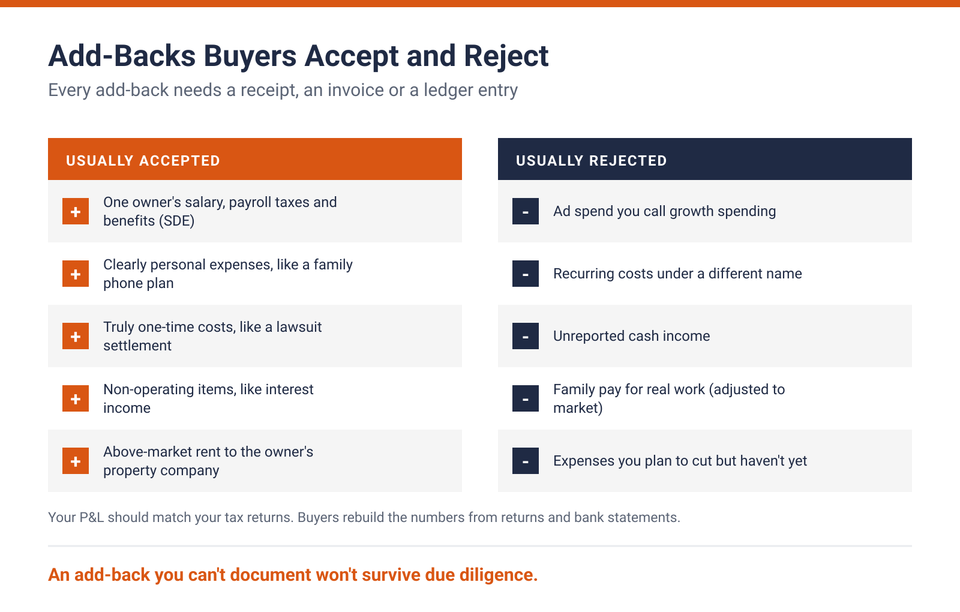
Here's the reality: an add-back that can't be documented won't survive diligence. Buyers, lenders and quality of earnings teams will rebuild your numbers from tax returns and bank statements. Every unsupported add-back gets cut, and your credibility goes with it.
Add-backs buyers usually accept:
One owner's salary, payroll taxes and benefits (for SDE)
Clearly personal expenses, such as a family phone plan or personal vehicle
Truly one-time costs, like a lawsuit settlement or a platform migration
Non-operating items, such as interest income or the gain on selling old equipment
Above-market rent paid to an owner's own property company (adjusted down to market)
Add-backs buyers usually reject:
Ad spend you call growth spending
Recurring costs that come back every year under a different name
Unreported cash income
Pay for family members who actually work in the business (adjusted to market, not removed)
Expenses you plan to cut but haven't cut yet
The rule is simple. Every add-back needs a receipt, an invoice or a ledger entry, and your P&L should match your tax returns. Recasting your financials before you list, with a clear schedule of each adjustment, shows buyers you have nothing to hide. Our guide to EBITDA add-backs goes through the gray areas in detail.
SDE and EBITDA for Online Businesses
Online businesses bend some of these rules. Many owners work remotely and part time, sometimes 15 hours a week or less. That cuts owner dependence and lowers the cost of replacing the owner. If a $60,000 part-time operator could do your job, the gap between SDE and adjusted EBITDA shrinks, and an EBITDA buyer may show up earlier than the size thresholds suggest.
Contractors need careful handling. Freelancers who write content, manage ads or handle customer support are real operating costs, not add-backs. If the owner's spouse is paid as a contractor for light work, buyers will adjust that pay to market rather than accept it as is.
Two more line items trip up online sellers:
Ad spend: treat it as a cost of doing business. Buyers will only accept a clearly failed one-time test campaign as an add-back, and only with records.
Platform fees:Amazon referral fees, Shopify apps, payment processing and app store cuts are operating expenses that won't go away after a sale.
E-commerce brands also carry inventory, so buyers will look at working capital alongside either metric. For a quick starting estimate, try our business valuation calculator.
Conclusion
SDE and EBITDA don't compete. They answer different questions for different buyers. SDE fits owner-run businesses earning under about $1 million that will sell to an individual buyer, often with SBA financing. Adjusted EBITDA fits larger companies with a management team that will sell to private equity or a strategic buyer. Between about $750,000 and $2 million, you should prepare both.
What protects your price is consistency. Pair each metric with its own multiple, support every add-back with documents, and know which buyer you're likely to attract before you set a number. A professional business valuation from Website Closers will show you which metric fits your company, what your recast earnings look like, and where your price is likely to land.
Ron has over two decades of experience in buying and selling online companies. He is a pioneer in the industry and for several years was affiliated with the largest business brokerage in the world. Consistently in the Top 10 brokers…
No. Profit, or net income, is what's left after all expenses, including the owner's salary, interest and taxes. SDE adds those items back, along with D&A, one-time costs and owner perks. It shows the total cash benefit one owner-operator gets from the business, so SDE is usually much higher than the net income on your tax return.
Why is SDE higher than EBITDA?
SDE adds back the owner's full salary, benefits and perks. Adjusted EBITDA replaces that pay with what it would cost to hire a manager at market rate. The gap between the two equals that replacement salary. Raw EBITDA is lower still, because it doesn't add back owner perks or one-time expenses at all.
At what size do buyers switch from SDE to EBITDA?
Most brokers place the switch around $1 million in earnings. Morgan & Westfield uses SDE below $1 million, and MidStreet's 2021 guidance puts EBITDA at about $1.5 million and up. Between about $750,000 and $2 million is a gray zone where the buyer type and owner involvement decide which metric applies.
When should EBITDA not be used to value a business?
EBITDA is a poor fit for small owner-run businesses where the owner does most of the work, since buyers will step into that role themselves. It can also mislead in capital-heavy companies, because it ignores the capex needed to replace equipment. In those cases, buyers lean on SDE, EBIT or free cash flow instead.
Is it better to use EBIT or EBITDA?
It depends on the business. EBITDA works well for asset-light companies like software, services and most online businesses, where depreciation is small. EBIT is often better for manufacturers, trucking firms and other capital-heavy businesses, because depreciation reflects real spending on equipment that a buyer will keep paying for after closing.
How much is a business worth with $1M in sales?
Sales alone won't tell you. Value depends on profit. A business with $1 million in revenue and a 20% SDE margin earns $200,000 in SDE. At a 2x to 3x SDE multiple, that suggests roughly $400,000 to $600,000. Higher margins, steady growth and low owner dependence push the value up from there.
Whether you’re interested in exiting your company or planning on acquiring a business, you have likely heard about SDE calculation or SDE business valuation. This is an important concept within buying and selling companies as the result of the calculation forms the basis of negotiations. Learn more about this valuation method in the following sections.…
When you prepare for a business valuation, the goal is to present your company’s true earning power. However, standard tax returns are often designed to minimize tax liability, not maximize the perceived value of a company. This is where EBITDA add-backs become the most powerful tool in a seller’s arsenal. By recasting or normalizing your…
5 min readRead more
Want to Sell Your Business Now? Get a Free Consultation!
A broker calls you back, usually within 1–2 hours
Confidential: nothing is shared without your consent