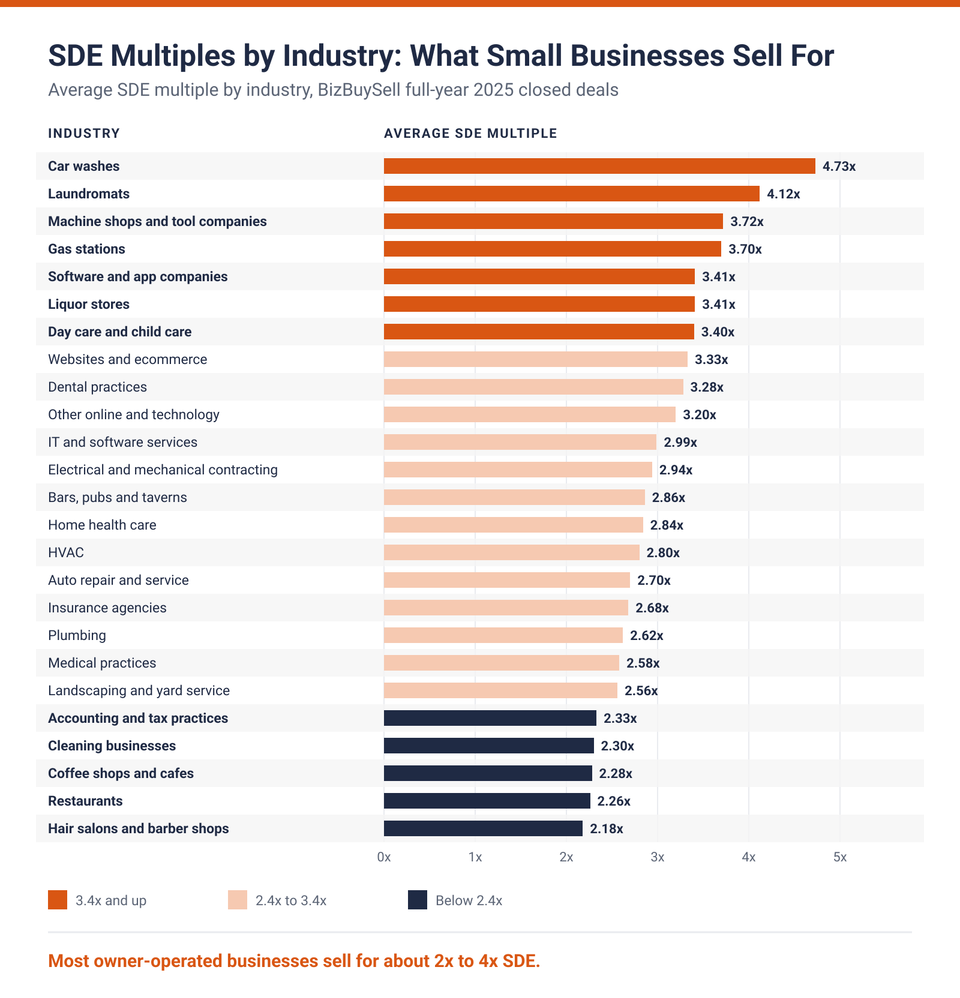
Quick answer: Most owner-operated small businesses sell for about 2x to 4x seller's discretionary earnings (SDE). BizBuySell's full-year 2025 data shows industry averages from 2.18x for hair salons to 4.73x for car washes. For lower-middle-market companies, Pepperdine's 2026 investment banker survey reports median EBITDA multiples of 3.5x to 5.0x under $1 million of EBITDA, rising to 7.0x to 8.5x at $10 million to $25 million. Private equity buyers paid an average 7.0x adjusted EBITDA in Q2 2026, according to GF Data.
Selling a business is a major financial decision, and understanding its potential value is an important first step. But business valuation is not as simple as applying an industry average to annual earnings. Buyers consider company size, profitability, growth, revenue stability, and operating risk before deciding what a business is worth.
This guide pairs SDE multiples by industry for Main Street businesses with EBITDA multiples by industry for lower-middle-market companies, so you can see which benchmark fits your size. Where a business lands within a range depends on several factors:
These figures are market benchmarks, not price guarantees. They also use different earnings measures and deal populations, so check the basis before comparing any two numbers.
SDE vs EBITDA Multiples: Which One Applies to You?
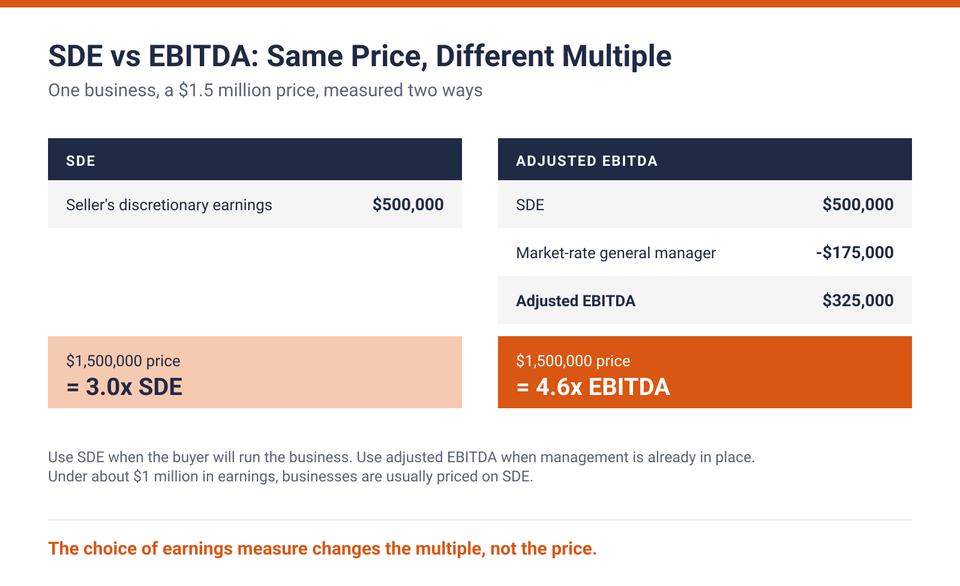
Use an SDE multiple when the buyer will run the business, and an EBITDA multiple when management is already in place.
The two measures treat owner pay differently:
SDE starts with pre-tax profit. It adds back interest, taxes, depreciation, amortization, one owner's salary and benefits, and supported personal or one-time expenses.
Adjusted EBITDA deducts a market-rate salary for whoever will manage the company after the sale.
As a rule of thumb, businesses earning under about $1 million are priced on SDE and larger companies on adjusted EBITDA. Deals near the line can use either.
The choice changes the multiple, not the price. A business with $500,000 in SDE that needs a $175,000 general manager has about $325,000 in adjusted EBITDA. A $1.5 million price is 3.0x SDE but about 4.6x EBITDA. For a deeper look at the earnings measure itself, see our guide to seller's discretionary earnings in business valuation.
SDE Multiples by Industry for Small Businesses (2027)
BizBuySell's full-year 2025 closed-transaction data is the most detailed public source of SDE multiples by industry. Brokers report sales voluntarily, so the data covers brokered deals rather than every private sale. BizBuySell calls SDE "cash flow." The multiples are averages; the sale price and SDE columns are medians.
Three points help when reading these small business valuation multiples by industry:
Averages run above typical deals. HVAC's median price ($800,000) divided by its median SDE ($315,225) is about 2.54x, below its 2.80x average. A few high-priced sales pull averages up.
Small samples move more. Restaurants had 1,774 reported sales; dental practices had 22. Treat thin categories as reference points, not anchors.
Business model drives the spread. Higher multiples: car washes and laundromats benefit from repeat demand and systems a buyer can run across locations. Online businesses rank high because their digital assets and revenue can transfer without the seller. Lower multiples: restaurants and salons carry thin margins, labor needs, lease exposure, and heavy owner involvement.
Size matters as well. BizBuySell's Q3 2026 Insight Report found that businesses selling for more than $1 million averaged 3.73x cash flow, versus 2.30x for those below $1 million. For the full calculation, see our guide to the multiple of seller discretionary earnings.
EBITDA Multiples by Industry for Lower Middle Market Companies
Once earnings pass about $1 million, a wider set of buyers prices deals on adjusted EBITDA:
private equity groups
family offices
search funds
strategic acquirers
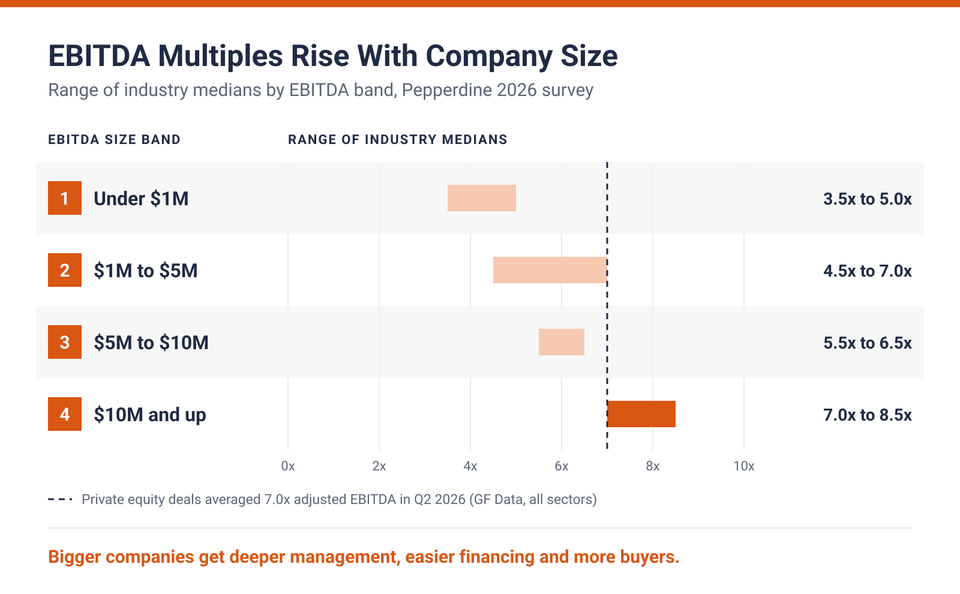
The best public source for an EBITDA multiple by industry and company size is the 2026 Pepperdine Private Capital Markets Report. It surveys investment bankers and reports median multiples on closed deals.
Source: Pepperdine 2026 Private Capital Markets Report, Table 31. Median multiples on closed deals reported by investment bankers.
Size is the clearest pattern. Business services companies under $1 million in EBITDA had a 4.8x median; at $10 million to $25 million, the median was 7.5x. That size premium reflects three advantages larger companies tend to have:
deeper management
easier financing
a larger buyer pool
The ladder is not perfectly smooth. Some bands flatten or dip because of survey sample size and deal mix. If you need an EBITDA multiple by industry for a private company, start with your sector's size band, then adjust for the risk factors covered below. For a refresher on the earnings measure itself, see what EBITDA means.
Across the seven sectors, the medians cluster by size band:
EBITDA size band
Range of industry medians
Under $1M
3.5x–5.0x
$1M–$5M
4.5x–7.0x
$5M–$10M
5.5x–6.5x
$10M+
7.0x–8.5x
Source: Pepperdine 2026, Table 31. Each range runs from the lowest to the highest industry median in that band; $10M+ combines the $10M–$25M and $25M+ columns.
GF Data tracks completed private equity–sponsored deals with enterprise values between $1 million and $500 million. According to ACG's August 27, 2026 release, contributing firms reported 85 transactions in Q2 2026. The average purchase price was 7.0x trailing 12-month adjusted EBITDA (often quoted as TEV/EBITDA), down from 7.3x in Q1.
GF Data attributed the dip to deal mix rather than weaker bids. Activity skewed toward smaller deals, and none closed above $250 million.
This is an all-sector average, not an average EBITDA multiple by industry. Size, sector and whether a deal is a platform or an add-on all move it. Use Pepperdine's table for sector comparisons and GF Data as a private equity reference point.
Multiples for Online and Tech Businesses
Online and tech businesses use the widest range of earnings measures:
SDE for owner-run stores
EBITDA for managed companies
revenue or ARR for subscription software
That makes revenue multiples by industry more useful here than anywhere else in this guide.
No reliable public closed-deal dataset; use disclosed comparables
—
What moves each model's multiple:
Ecommerce and Amazon FBA: Channel concentration is the main discount. FE International places dropshipping and single-product Amazon models at the bottom of its ranges. Brands with owned audiences and subscription revenue sit at the top.
SaaS and apps: Buyers price ARR growth, retention, churn and gross margin. SEG's index tracks public companies, so read it as market sentiment rather than a private sale price.
Content and affiliate sites: Traffic-source mix and history through search updates drive value. A site that relies on one search engine or affiliate program carries more risk.
IT services and MSPs: Contracted monthly recurring revenue, renewal rates and technical staff retention support higher multiples.
Buyer expectations differ across these models. Our guide shows how they compare when you sell your business by industry.
Why Public Company Multiples Don't Apply to Your Business
Public company data dominates search results for valuation multiples by industry, but it does not price a small private business.
BizBuySell: the average Main Street deal in Q2 2026 closed at 2.7x cash flow.
The earnings measures differ, so the gap is not a precise public vs private discount. It does show why these industry valuation multiples cannot be copied across. Three factors drive the difference:
Size and risk: Public companies have scale, diversified revenue and deep management. Small businesses may depend on a few customers or the owner.
Liquidity: Public shares trade instantly. A private sale takes months of diligence and a limited pool of qualified buyers.
Owner dependence: A public company survives an executive's exit. A small business may lose key relationships when its owner leaves.
Use public multiples to read sector sentiment, not to price a private deal.
What Moves Your Multiple Up or Down
Industry and size set the starting range; risk decides where you land in it. A business with predictable revenue, low customer concentration risk, capable management and clean records is easier to finance and attracts better offers.
Factor
Effect on the multiple
How to improve
Size
More earnings widen the buyer pool and ease financing. Pepperdine's medians rise with each EBITDA band in most sectors.
Grow earnings before a sale and build a management layer.
Growth
Two to three years of steady revenue and profit growth support the upper range. One-off spikes do not.
Show consistent trailing growth and explain any unusual quarters.
Recurring revenue
Contracts, subscriptions and maintenance plans make earnings easier to forecast.
Convert repeat customers into contracts or memberships.
Customer concentration
One dominant customer can mean a lower multiple, a holdback or an earnout.
Diversify revenue and lengthen key contracts.
Owner dependence
Relationships and know-how held by the owner are a transfer risk.
Delegate sales and operations; document procedures.
Clean books
Gaps between statements and tax returns delay diligence or cut the price.
Reconcile accounts and consider reviewed financial statements.
Add-backs
Supported add-backs raise SDE or adjusted EBITDA. Unsupported ones fail a quality of earnings review.
Keep invoices and payroll records for each item.
So, what is a good EBITDA multiple?
A good EBITDA multiple is one at or above the median for companies of your industry and size. Two examples from the Pepperdine table:
A business services firm with $2 million in EBITDA can start from Pepperdine's 6.2x median.
A manufacturer with $15 million in EBITDA can start from 7.0x.
Growth, recurring revenue, and a strong management team argue for more. Weak reporting or heavy owner dependence argues for less.
What is a good EBITDA multiple for an acquisition depends on which side you are on. A buyer should check earnings quality, EBITDA add-backs, capital expenditure, and working capital before treating a low multiple as a bargain. Strategic acquirers may pay more when they can realize cost savings or reach new customers. Financial buyers focus on the return they can earn through growth and debt repayment.
How to Use These Multiples to Estimate Your Business Value
Business valuation multiples turn normalized earnings into a value range. Follow five steps:
Choose the earnings measure. Use SDE for an owner-run business and adjusted EBITDA for one with management in place.
Normalize earnings. Start with the trailing twelve months, review the prior two to three years, and keep only documented add-backs.
Pick comparables. Match your industry, ideally by NAICS code, and your size band. Draw on sources such as BizBuySell, DealStats, Pepperdine, or GF Data, and note whether each reports an average or a median.
Place the business range. Score it on the factors above. Strengths support a position above the median; material weaknesses put it below.
Calculate and adjust. Multiply earnings by the low and high multiples. Then adjust for debt, cash, working capital, and deal terms.
Worked Example: An ecommerce business earns $600,000 in SDE. BizBuySell's 2025 average for websites and ecommerce is 3.33x. An illustrative range of 2.5x to 4.0x gives an enterprise value of $1.5 million to $2.4 million, or about $2.0 million at the average. If 80% of sales come from Amazon, expect offers near the low end. Diversified channels and a manager who runs daily operations support the high end.
If you are near the $1 million earnings line, test both measures. Individual buyers will apply an SDE multiple, while private equity buyers will look for an EBITDA multiple for small business acquisitions.
Deal terms also change what you take home. Smaller deals often rely on an SBA 7(a) loan, so lender requirements and interest rates affect what buyers can pay. Larger deals may include seller notes, earnouts, or rollover equity. Two offers with the same headline value can deliver very different cash at closing.
Business valuation multiples in 2027 depend on company size, industry, and earnings measure used. The main benchmarks:
Owner-operated businesses mostly sell for 2x to 4x SDE, with car washes and laundromats above that range in BizBuySell's 2025 data.
Lower-middle-market companies trade at EBITDA medians that rise toward 7x to 8.5x as they grow, according to Pepperdine's 2026 survey.
Private equity deals averaged 7.0x in Q2 2026, per GF Data.
Where a business lands within those ranges depends on earnings quality, recurring revenue, customer concentration, and the owner's role. Sellers who address these issues before going to market negotiate from a stronger position.
If you are considering selling an online, technology or service business, the Website Closers team can review your financials, identify relevant comparables and explain what is likely to move your multiple. Request a confidential valuation to get started.
With nearly two decades of experience as an M&A broker at Website Closers, I specialize in helping entrepreneurs successfully navigate the process of exiting their businesses. Having represented a wide range of companies across numerous industries, I bring extensive experience…
What is a good EBITDA multiple for a small business?
A good EBITDA multiple for a small business is usually 4x to 6x for companies with $1M to $5M of EBITDA, and 6x to 8x or more above that. Businesses earning less than about $1M are normally priced on SDE instead, at 2x to 4x. A multiple at or above the typical ranges for your size and industry is a strong result.
Which industry has the highest EBITDA multiples?
Software, healthcare services and specialized business services usually command the highest EBITDA multiples, often 8x to 12x or more at scale. They share recurring revenue, high margins, low capital needs, and deep buyer demand. Among main street businesses, semi-passive, asset-backed businesses such as car washes, laundromats, self-storage, and funeral homes tend to earn the highest SDE multiples, around 4x to 5x.
What does a 10x EBITDA multiple mean?
A 10x EBITDA multiple means a buyer pays an enterprise value equal to ten times the company's annual EBITDA. A business with $2M of EBITDA would be valued at $20M before subtracting debt and adding cash. That implies roughly a 10% pre-tax return, so buyers only pay it when they expect strong growth. In private markets, 10x is generally reserved for larger, high-quality companies.
Is a business worth 3 times profit?
Many small businesses do sell for about 3 times profit, but only when "profit" means SDE, which includes the owner's salary and perks. Most Main Street businesses sell for 2x to 3x SDE. If you measure profit after paying a full owner salary, the multiple will look higher. Larger companies priced on EBITDA usually sell for 4x or more.
How much is a business worth with $1,000,000 in sales?
A business with $1M in sales is often worth roughly $400,000 to $1.5M, but the real answer depends on profit, not revenue. Small businesses typically sell for 0.4x to 1.5x annual revenue, with low-margin businesses like restaurants at the bottom and recurring-revenue businesses like insurance agencies at the top. A more reliable method is to multiply your SDE by your industry's SDE multiple.
Why are SDE multiples lower than EBITDA multiples?
SDE multiples are lower because SDE is a larger earnings figure and because SDE-priced businesses carry more risk. SDE adds back the owner's entire salary, so the same price divided by SDE produces a smaller multiple. SDE businesses are also usually smaller, more owner-dependent, and harder to finance, which means fewer buyers and less paid per dollar of earnings.
Do valuation multiples include real estate and inventory?
Valuation multiples usually cover the operating business only, not real estate or inventory. Real estate is typically sold separately or leased to the buyer at market rent. Inventory is often added to the price at cost. When comparing your business to recent sales, check how each deal treated these assets.
How can I increase my business's valuation multiple?
You can increase your multiple by making the business less dependent on you, growing recurring revenue, cleaning up your financial records, and reducing customer concentration. Running a competitive sale process with several qualified buyers also lifts the final price. Start 12 to 24 months before you plan to sell, since most of these changes take time to show up in your numbers.
Whether you’re interested in exiting your company or planning on acquiring a business, you have likely heard about SDE calculation or SDE business valuation. This is an important concept within buying and selling companies as the result of the calculation forms the basis of negotiations. Learn more about this valuation method in the following sections.…
You could be making a big mistake when you plan to sell with EBITDA as your main driver. While it’s a common valuation metric, the truth is that it does not represent actual cash flow. In other words, it’s not the entire story of your company’s earnings. Search for “ebitda vs valuation” and you’ll learn…
Owners can’t help but be fixated on the final sale price when they’re getting prepped for an exit. But what they’re not aware of is that the figure coming out on a valuation is adjustable. In other words, it’s not a question of “How much can I sell this for?” Instead, it can be “How…
18 min readRead more
Want to Sell Your Business Now? Get a Free Consultation!
A broker calls you back, usually within 1–2 hours
Confidential: nothing is shared without your consent