


On this page
Quick answer: Selling an insurance agency starts with a valuation built on adjusted EBITDA and retention, not a commission rule of thumb. Before you go to market, clean up your carrier contracts and producer agreements so the book can transfer without surprises. Then decide between an outside sale and internal perpetuation, and negotiate the structure (cash at close, earnout, installments) as hard as you negotiate the price.
Selling an Insurance Agency in Today's M&A Market
Say you own a commercial lines agency with $2.4 million in commission revenue, and a private equity-backed broker calls with an offer. That night you search "how to sell my insurance agency," then "how much is my insurance agency worth." Both searches point to the same lesson: before you sell your business, you need to know what the agency is worth to more than one buyer. That first offer might hold back 30% of the price as an earnout tied to retention, and it might leave your top producer free to walk.
Insurance agency mergers and acquisitions slowed last year, and the wider insurance M&A market is more selective. OPTIS Partners counted 695 insurance agent and broker deals announced in North America in 2025, down 12% from 787 in 2024 and 24% below the previous five-year average. Q4 2025 brought 157 deals, the lowest quarterly count since 2019. Buyers are still active, but they look harder at retention, margins and producer contracts.
That is why a confidential, competitive process matters. One buyer sets the terms, while several buyers bidding against each other set the market. And your staff, carriers and clients shouldn't hear about a sale until the deal is close. We run that process for agency owners from valuation through closing, whether you're weighing an offer now or planning an exit a few years out.
Insurance Agency Valuation: How Much Is Your Agency Worth?
An insurance agency valuation answers two questions: how much cash flow the agency produces, and how likely that cash flow is to stay after you leave. Buyers start with earnings, then test them against retention, producer contracts and the mix of business.
EBITDA vs. Revenue Multiples for Insurance Agencies
Most buyers today price an agency on a multiple of adjusted EBITDA. Adjusted EBITDA starts with earnings and adds back the owner's above-market salary, personal expenses and one-time costs, so the buyer sees what the agency earns under new ownership.
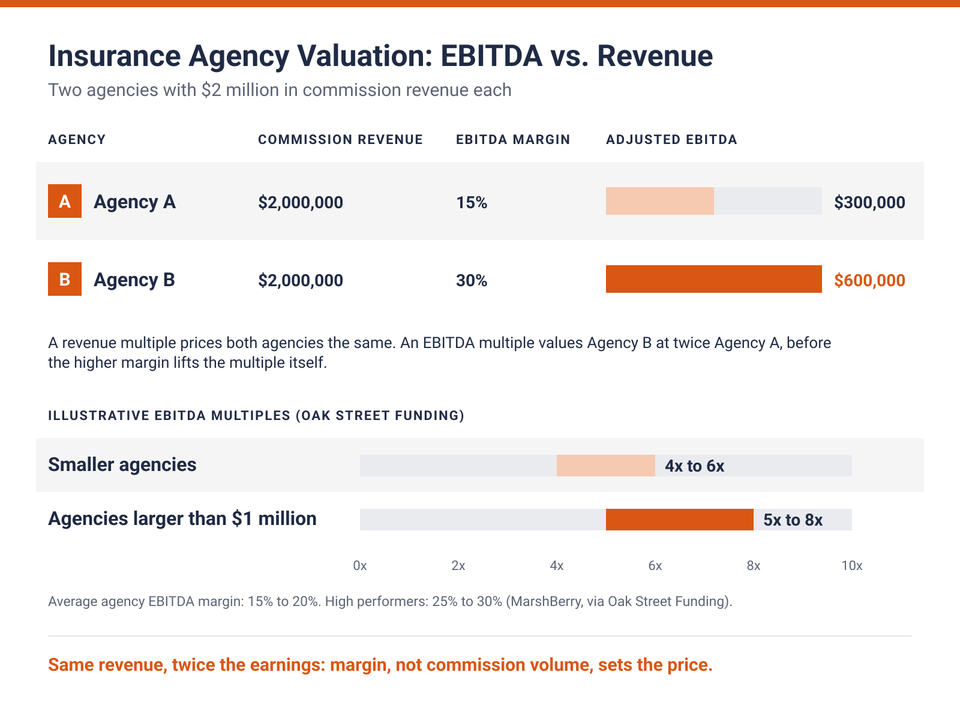
Commission rules of thumb, such as a multiple of annual revenue, still get quoted. They mislead because they treat every dollar of commission revenue the same. Take two agencies with $2 million in revenue each. One runs at a 15% margin and earns $300,000. The other runs at 30% and earns $600,000. A revenue multiple prices them the same, while an EBITDA multiple values the second at twice the first, before the higher margin lifts the multiple itself.
Citing MarshBerry, Oak Street Funding puts average agency EBITDA margins at 15% to 20%, with high performers at 25% to 30%. The same lender's analysis says smaller agencies often sell for roughly 4 to 6 times EBITDA, while agencies larger than $1 million tend to fetch 5 to 8 times. Treat those as illustrative, since insurance agency valuation multiples shift with size, growth, and buyer type.
For a rough starting point, an insurance agency valuation calculator helps. Try our free valuation calculator, then talk to us about insurance agency valuation services when you need a number you can take to buyers.
What Drives Insurance Agency Value
Two agencies with the same EBITDA can sell for very different prices. The gap comes from risk, which buyers measure through these drivers.
Driver | Effect on value | Proof buyers want |
|---|---|---|
Retention rate | High retention supports a higher multiple and a smaller earnout | Three to five years of retention by line and producer |
Organic growth | Steady growth without acquisitions earns a premium | New business and renewal revenue by year |
Revenue mix | Commercial lines and employee benefits usually price higher than P&C personal lines or life and health | Commission revenue split by line of business |
Carrier concentration | Heavy reliance on one carrier adds risk | Carrier appointments, carrier contracts and premium by carrier |
Producer age and agreements | Older producers or missing agreements lower the price | Producer agreements with non-solicitation terms, plus book ownership |
Owner dependence | An owner who handles top accounts personally creates transition risk | Account service assignments and an org chart |
Contingent income | Buyers discount contingent commissions because they swing year to year | Five years of contingent commission history |
Account concentration | A few large accounts can cut the multiple | Revenue by client, top 10 and top 25 |
Technology and AMS | A clean agency management system speeds diligence and the handoff | Clean AMS reports and licensing records |
EBITDA margin | Higher margins lift both earnings and the multiple | Adjusted EBITDA with documented add-backs |
Our guide on account concentration risk shows how buyers read client mix and why it changes their offer.
Selling an Insurance Book of Business vs. the Whole Agency
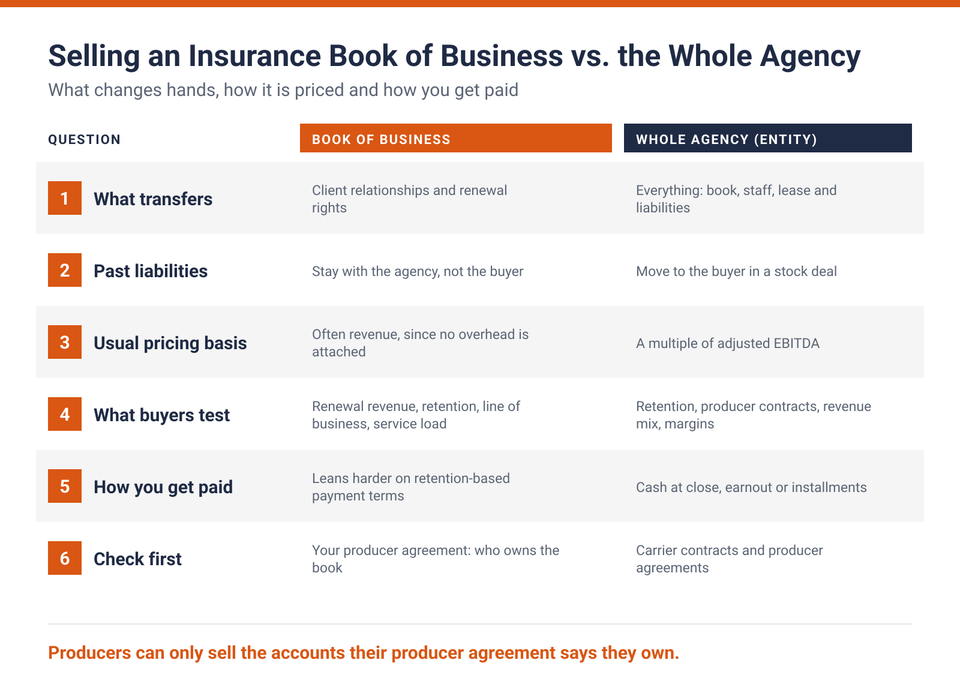
Not every seller needs to sell the entity. A producer looking to sell insurance book of business accounts can transfer the client relationships and renewal rights while the agency, lease, staff and liabilities stay with someone else. An entity sale moves everything, including past liabilities in a stock deal.
An insurance book of business valuation works much like an agency valuation, only narrower. Buyers focus on renewal revenue, retention, line of business and how much service the accounts need. Because a book has no overhead attached, buyers often price it on revenue rather than EBITDA, and they lean harder on retention-based payment terms.
Producers have one extra step. Selling insurance book of business accounts you service only works if you own them, and your producer agreement decides that. It also spells out any non-solicitation clause, so read it, ideally with an attorney, before you talk to a buyer.
Who Buys Insurance Agencies?
Private equity-backed brokers and aggregators drive most of the volume. OPTIS Partners ranked two PE-backed brokers as the most active buyers of 2025, with 69 and 49 deals. They pay well for scale and clean data and usually want the seller to stay on for a transition period.
Publicly traded brokers buy fewer agencies and tend to target larger shops with strong commercial lines or employee benefits books. Regional agencies buy to add territory or fill a gap in their product mix, and they often care more about culture and staff than an aggregator does. Agency networks and clusters let you keep ownership while sharing carrier access, which can raise value before a later sale.
Then there is internal perpetuation. A sale to key producers or family members keeps the agency independent, but those buyers rarely have the cash, so installments carry the deal.
Our insurance agency M&A advisory team brings these buyer types to the same table. If you're on the buy side, browse our insurance and financial businesses for sale.
How to Sell an Insurance Agency, Step by Step
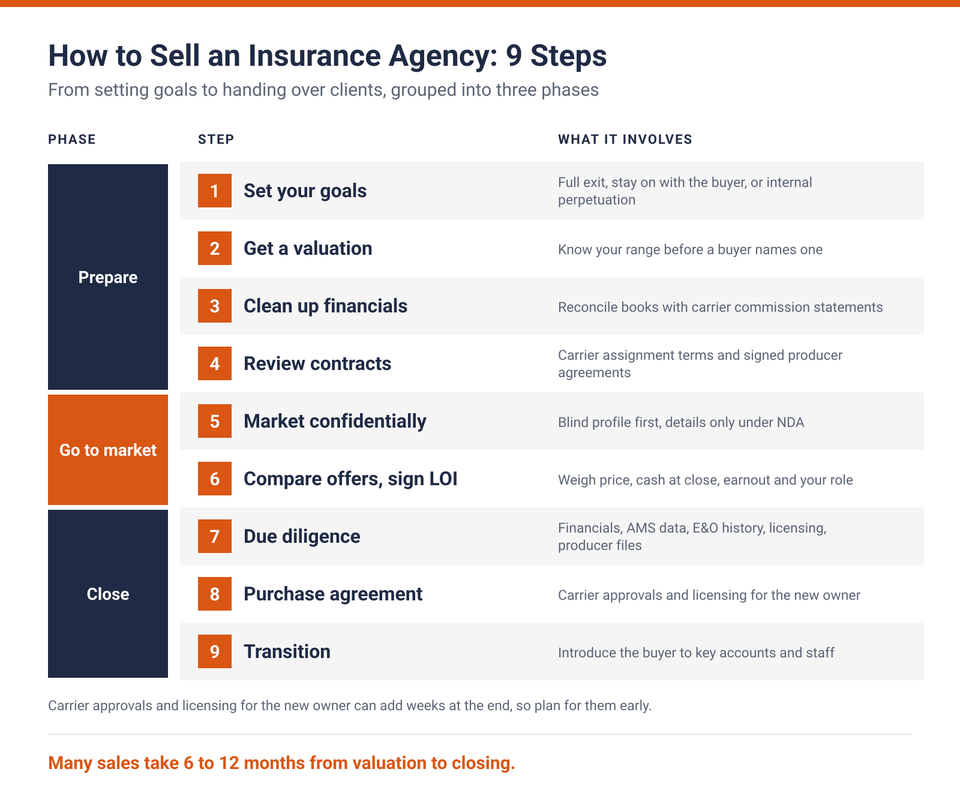
Every insurance agency acquisition follows a similar path, whether the buyer is an aggregator or your top producer.
- Set your goals. Decide between a full exit, a few years working for the buyer or internal perpetuation. Your answer shapes which buyers make sense.
- Get a valuation. Know your range before a buyer names one.
- Clean up financials and commission statements. Reconcile your books with carrier commission statements and separate personal expenses.
- Review carrier contracts and producer agreements. Confirm which carrier contracts allow assignment and that every producer has a signed agreement covering book ownership and non-solicitation.
- Market the agency confidentially. Share a blind profile first, then details only with qualified buyers under NDA.
- Compare offers and sign an LOI. Weigh price, cash at close, earnout terms and your post-sale role before the letter of intent locks them in.
- Get through due diligence. Expect requests for financials, AMS data, E&O coverage history, licensing records and producer files. Our due diligence checklist shows what to gather early.
- Sign the purchase agreement and secure approvals. Carriers must approve appointments or transfers, and licensing has to be in place for the new owner before closing.
- Transition clients and staff. Introduce the buyer to key accounts and follow the agreed transition plan.
Want to see how each stage works in practice? Walk through our sale process.
Deal Structure: Cash, Earnouts and Installments
Structure decides what you actually take home. Most agency deals are asset sales, where the buyer acquires the book, client lists and other assets, partly because that structure favors the buyer at tax time. Owners who sell insurance agency stock instead hand over the entity along with their past liabilities, which is why buyers in those deals often require E&O tail coverage. The two structures carry different tax results, so your CPA should model both before you sign an LOI.
Earnouts tie part of the price to future performance, usually retention or revenue over one to three years. Read the measurement terms closely, since accounts lost for reasons outside your control can still cut the payout.
An installment sale spreads payments out. The Independent Insurance Agents & Brokers of America notes that an independent agency can be sold in installments, usually over three to five years. Most deals also include an employment or consulting agreement and a non-solicitation clause that bars you from taking clients after closing. Negotiate both alongside the price.
Independent vs. Captive Agencies
An independent agency owns their book of business. The client relationships, expirations and renewal rights belong to the agency, and they can move to a buyer as long as carrier appointments transfer.
Captive agents play by different rules. At carriers such as Allstate and State Farm, the carrier agreement controls what can be sold, to whom and with what approval. Some captive agents can sell their economic interest to an approved buyer, while others cannot sell the book at all. If you run a captive agency, read your carrier agreement first and confirm your rights before you plan a sale.
Why Sell Your Insurance Agency With Website Closers
Website Closers acts as an insurance agency broker and M&A advisor for owners who want a clean exit at a fair price.
- National buyer database: We reach PE-backed brokers, regional agencies, strategic acquirers and individual buyers across the country.
- Confidential process: Buyers sign an NDA before seeing details, so staff and carriers aren't caught off guard.
- Valuation: We build your number from adjusted EBITDA, retention and the drivers buyers care about.
- Deal structuring: We help you weigh cash at close, earnouts and installments so the terms match your goals.
If your agency also offers lending or investment services, see our page on selling a finance company.
Get a Confidential Agency Valuation
You don't need to be ready to sell tomorrow. A confidential valuation shows where you stand, what buyers will question and what to fix before going to market. It also gives you a benchmark for the next unsolicited offer. When you're ready, talk to an M&A advisor about your agency. Every conversation stays private.
FAQs (Frequently Asked Questions)
How much do insurance agencies usually sell for?
Most agencies sell for a multiple of adjusted EBITDA. Oak Street Funding notes that smaller agencies often sell for about 4 to 6 times EBITDA, and agencies larger than $1 million for 5 to 8 times. Retention, growth, margins, and producer contracts move an agency up or down within those ranges.
How do you calculate the value of an insurance agency?
Start with adjusted EBITDA: earnings plus owner add-backs and one-time expenses. Multiply that figure by a multiple that reflects risk, which depends on retention, organic growth, revenue mix, carrier concentration, and owner dependence. A professional valuation tests each of those drivers against the records a buyer will ask for in due diligence.
What are typical valuation multiples for insurance agencies?
Insurance agency multiples depend on size and quality. Oak Street Funding reports that average multiples have hovered around 10.6 times EBITDA since 2021, while smaller agencies usually sell well below that. Agencies with high margins, strong retention and organic growth land toward the top of the range, especially when several buyers compete.
How long does it take to sell an insurance agency?
Many sales take six to twelve months from valuation to closing, and preparation can add time before that. Clean financials, signed producer agreements and organized AMS data speed things up. Carrier approvals and licensing for the new owner can add weeks at the end, so plan for them early.
What are the tax implications of selling an insurance agency?
Tax results depend mostly on structure. Asset and stock sales are taxed differently, and the allocation of the price among goodwill, non-compete payments and consulting fees also matters. Installment sales can spread the tax over several years. Talk to a CPA before you sign an LOI so you understand the after-tax value of each offer.
Can I sell just my book of business instead of the whole agency?
Yes. Many owners and producers sell only their book of business, transferring client relationships and renewal rights while keeping the entity. The value of an insurance book of business assets depends on retention, line of business, and renewal revenue. Producers should check their producer agreement first, since it controls who owns the book.
What is your business worth?
Five answers, a range in seconds. No email needed.
Estimated value
Add your revenue and profit to see your range.
A wide range from five answers. Add your profit and loss and what makes the business valuable to narrow it.