


How Do I Decide Which Business Broker Is Best?
How to choose a business broker: interview questions, a scorecard for comparing firms, credentials that matter and red flags to spot before you sign.
7 min read


Quick Summary via AI:
A technology business broker is an intermediary who specializes in selling software, SaaS, ecommerce, IT services and other tech-enabled companies. The right one understands recurring revenue, code ownership and platform risk well enough to defend your price in front of sophisticated buyers. The fastest way to find that person is to interview several brokers with the same set of pointed questions, then compare the answers side by side.
A tech broker runs the full sell-side process for an internet or software company. In practice that covers five jobs:
The "technology" label covers a wide range of models: SaaS companies, ecommerce stores, Amazon FBA brands, digital agencies, app developers, content sites and managed service providers. Each one is valued differently, which is why industry fit is the first thing to test.
A Main Street broker who mostly sells restaurants and franchises can still close a deal, but tech buyers ask different questions. They want to know whether revenue is contracted or transactional, who owns the code, how dependent the business is on one platform or ad channel, and how much of the operation lives in the founder's head. If your broker cannot answer those questions with confidence, buyers discount the price to cover the uncertainty.
Factor | Generalist business broker | Technology business broker |
|---|---|---|
Valuation focus | Seller's discretionary earnings and hard assets | SDE or EBITDA plus recurring revenue, churn, growth rate and IP |
Typical buyers | Local owner-operators | Strategic acquirers, PE groups, search funds, online entrepreneurs |
Diligence depth | Financials, leases, equipment | Financials plus code, tech stack, data, platform accounts and contracts |
Platform risk | Rarely assessed | Assessed for Amazon, Shopify, Google, app stores and ad channels |
Marketing reach | Local listings and directories | National and international buyer databases and direct outreach |
Deal structures | Mostly cash and SBA loans | Cash, SBA loans, seller notes, earn-outs and equity rollovers |
For a deeper look at how buyers price software, see our guide to understanding SaaS valuation. If you want a broader framework for comparing firms of any type, our article on how to decide which business broker is best covers credentials, references and red flags.
Use these questions in every first meeting. Write the answers down so you can compare brokers after the calls.
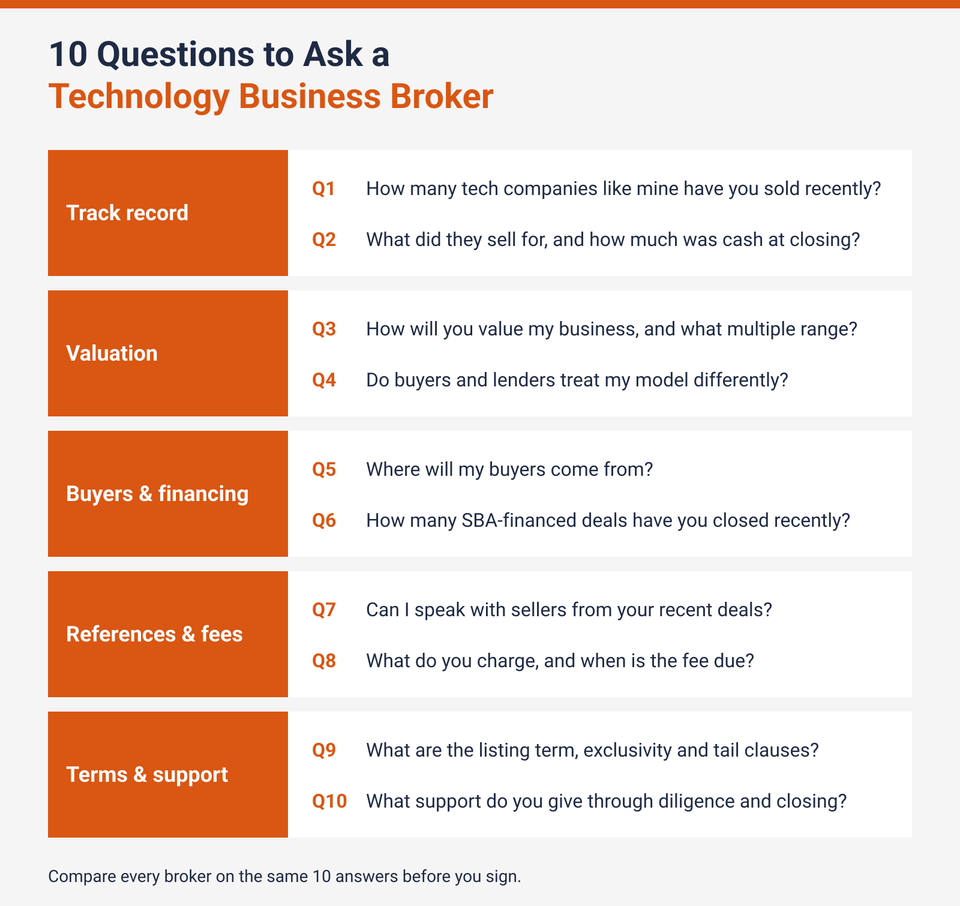
After three or four interviews, compare brokers on evidence, not enthusiasm.
Red flags include large upfront fees, long exclusive terms with no performance exit, no recent references, and vague answers about how buyers are found.
Most broker-led technology sales follow the same sequence, whatever the business model:
Recurring, predictable revenue tends to shorten diligence and support a higher multiple. If you are still a year or two from selling, our article on using recurring revenue models to increase exit value shows where to start.
A good technology business broker earns the fee by pricing your company on the metrics tech buyers care about, reaching the right buyers and keeping the deal together through diligence. Interview several firms, ask all 10 questions and choose the broker whose answers are specific, verifiable and backed by recent deals in your niche.
Website Closers has specialized in selling internet and technology businesses since 1998 and works on a success-fee basis with no upfront fees. If you are weighing an exit, learn how our team approaches selling a technology business, or request a confidential valuation and start the conversation about selling your business.
A technology business broker manages the sale of a software, SaaS, ecommerce, IT services or other tech-enabled company. The broker values the business, prepares confidential marketing materials, finds and screens buyers, negotiates price and deal structure, and coordinates due diligence through closing. A specialist also knows how to present recurring revenue, code ownership and platform risk, which are the details tech buyers scrutinize most closely.
A general broker usually sells local Main Street businesses and values them mainly on seller's discretionary earnings and physical assets. A tech broker also prices recurring revenue, churn, growth, intellectual property and platform dependence, and reaches a national pool of strategic acquirers, private equity groups and online entrepreneurs. That specialized buyer network and valuation method often makes the difference between a stalled listing and a closed deal.
Most technology business brokers charge a success fee, a percentage of the sale price paid at closing, and the percentage usually falls as the deal size rises. Some firms also charge upfront retainers, marketing fees or minimum fees. Before signing, ask how the fee is calculated, whether it applies to seller notes and earn-outs, and what you owe if the business does not sell.
In a typical sell-side engagement, the seller pays the broker's fee out of the sale proceeds at closing. The fee terms are set in the listing agreement you sign before the business goes to market. Buyers sometimes hire their own buy-side advisors and pay them separately, but that arrangement does not change what the seller owes under its own broker agreement.
Ideally one to two years before you plan to sell. Early conversations give you time to clean up financial records, reduce owner dependence, document processes and strengthen recurring revenue, all of which can raise your valuation. A broker can also tell you whether current market conditions favor selling now or waiting, and what buyers in your niche are paying for businesses like yours.
How to choose a business broker: interview questions, a scorecard for comparing firms, credentials that matter and red flags to spot before you sign.

What a business broker agreement covers: term, exclusivity, commission, tail provision and termination, plus what to negotiate before you sign.

Learn how SaaS valuation multiples work, when buyers use ARR, EBITDA or SDE, what current deal data shows, and which metrics move your company's price.

Prefer to talk?
800-251-1559