


How Does the Process of Selling an Online Business Typically Kick Off?
How to sell your online business, starting right: valuation, clean financials, broker choice, NDAs, buyer calls and the LOI, plus a typical sale timeline.
8 min read


Quick Summary via AI:
Knowing how to sell an internet business looks simple from the outside: list it, field offers, sign. In practice, most owners only sell once, and the mistakes that cost the most money are the ones that feel like common sense. Take the 10-question true-or-false quiz below to see how ready you are, then use the answers to plan your exit.
Answer each statement with true or false before you scroll to the answers.
Question | Answer | Short explanation |
|---|---|---|
Q1: Sell by owner nets more | False | You save the fee but carry valuation, marketing, screening, and negotiation yourself |
Q2: Never move on price | False | Buyers pay for terms as well as price; flexibility often raises net proceeds |
Q3: Know your own numbers | True | Buyers test the owner, not just the spreadsheets |
Q4: Timing does not matter | False | Trailing 12-month results drive the price, so timing changes the number |
Q5: Document the business | True | Documented processes lower the buyer's risk and support a higher multiple |
Q6: Expect a non-compete | True | Buyers want to protect the goodwill they are paying for |
Q7: Treat every inquiry the same | False | Unqualified buyers waste time and can expose sensitive data |
Q8: Professional valuation wins | True | Calculators miss add-backs, risk factors, and deal structure |
Q9: Any broker will do | False | Online businesses need specialists in traffic, platforms, and digital transfers |
Q10: Confidentiality matters | True | Leaks can unsettle staff, suppliers, customers, and competitors |
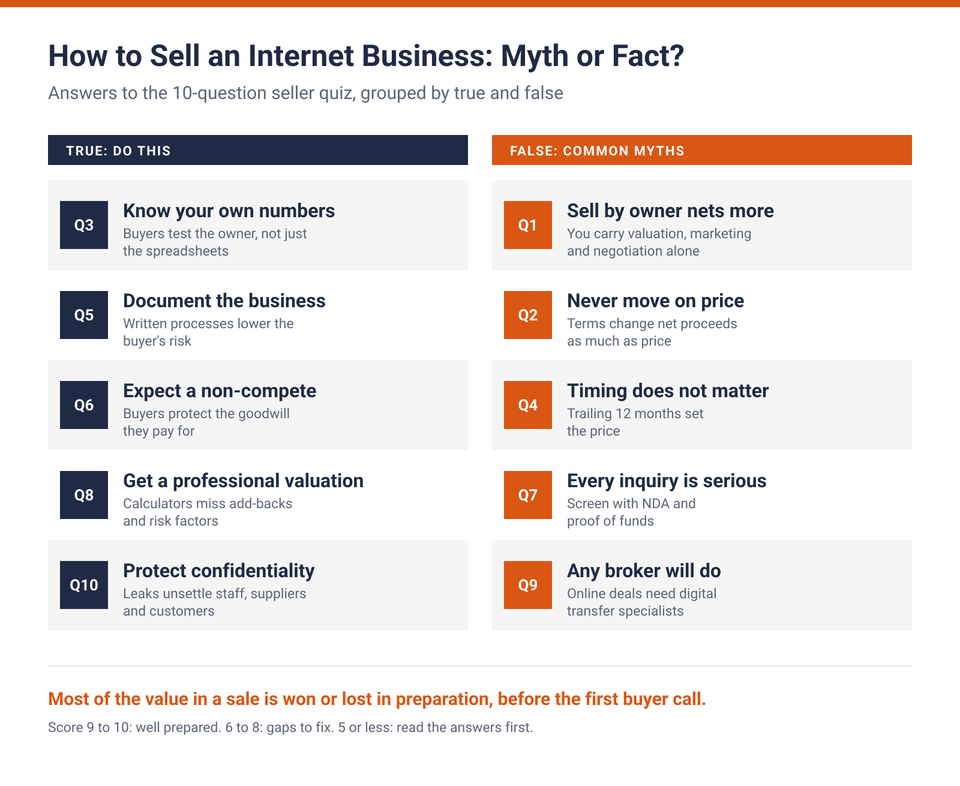
Scored 9 or 10? You are well prepared. Scored 6 to 8? You know the basics but have gaps that could cost you at the negotiating table. Scored 5 or less? Read the explanations below before you talk to any buyer.
Selling on your own saves the broker's fee, but you take on every job the broker would do: valuing the business, preparing the offering memorandum, marketing it confidentially, screening buyers, negotiating terms, and managing due diligence. Owners who sell alone often underprice, accept weaker terms, or lose months to buyers who were never qualified. What matters is net proceeds, not whether you paid a fee. We compare both routes in detail in should you use an intermediary or sell your online business yourself.
A buyer offering your full asking price with a large earn-out may be worth less than a slightly lower all-cash offer. Cash at closing, seller financing, earn-outs, transition support, and the working capital you leave behind all change what you actually take home. Go in with a target range and a clear walk-away point, and be ready to trade on terms. Our guide to negotiating the sale of an online business covers how to do that without giving away value.
Accountants prepare the statements, but buyers will ask you why revenue dipped in March, which expenses are one-time, and what your customer acquisition cost is by channel. Owners who answer confidently build trust; owners who say "ask my bookkeeper" raise red flags. Before you list, be able to explain your profit and loss statement, your add-backs, and your traffic sources line by line.
Buyers usually value an online business on its trailing 12 months of earnings, so selling after a strong year produces a very different number than selling after a weak one. Seasonality, platform changes, and the general deal market also matter. Selling takes time too, often several months from preparation to closing, so start planning before you need to sell. See how long it takes to sell an online business and how to keep it confidential.
A buyer is not just buying revenue; they are buying the ability to keep it. Written procedures for fulfillment, customer service, content production, advertising, and supplier management prove the business can run without you. That reduces the buyer's risk and supports a stronger multiple.
A buyer paying for your customer relationships, brand, and know-how will want assurance that you will not open a competing business next month. Non-competes tied to the sale of a business are standard, and their scope, length, and geography are negotiable. Enforceability depends on state law, so have your attorney review the terms. Read more in how to structure a non-compete agreement in a sale, and decide what you will do after the sale before you agree to restrictions.
Many inquiries come from tire-kickers, competitors fishing for information, or buyers without the funds to close. Screen every buyer before sharing details: require a signed NDA, confirm proof of funds or financing, and understand their experience and plans. Release sensitive data such as supplier names and exact traffic sources in stages, only as a buyer proves serious.
Free calculators apply a generic multiple to the numbers you type in. A professional business valuation also looks at normalized earnings and add-backs, growth trends, traffic and platform risk, customer concentration, and what similar businesses have actually sold for. That analysis gives you a defensible asking price and the arguments to support it.
A broker who sells restaurants or commercial property may be excellent at that work, but internet businesses raise different questions: Google and Amazon algorithm risk, traffic quality, ad account and domain transfers, platform terms, and recurring revenue metrics. Whether you are selling a website, an ecommerce business, or a SaaS company, choose an advisor who has closed deals like yours.
If employees, suppliers, or customers hear about a sale too early, they may leave, renegotiate, or lose confidence, and competitors may use the news against you. A confidential sale uses blind listings, NDAs, staged disclosure, and a single point of contact for buyers.
Once you know the common traps, the process itself follows a clear order:
For a closer look at the first stage, read how the process of selling an online business typically kicks off.
Selling an internet business rewards owners who prepare: know your numbers, document the business, protect confidentiality, and judge offers on terms as well as price. If the quiz exposed a few gaps, that is the point; it is far cheaper to fix them now than in the middle of a negotiation.
When you are ready to talk about your exit, Website Closers can value your business and guide you from listing to closing. Learn how we help owners sell their business, or review our process first.
Start by cleaning up two to three years of financials and documenting how the business runs. Get a professional valuation to set a realistic price, then market the business confidentially and screen buyers with an NDA and proof of funds. Negotiate a letter of intent on price and terms, complete due diligence, and transfer domains, accounts, and assets under a written transition plan.
Yes. Owners can sell privately or through a marketplace listing. You avoid a broker's fee, but you handle valuation, marketing, buyer screening, negotiation, and due diligence yourself. Many owners find that a specialist broker increases net proceeds through better pricing, a wider pool of qualified buyers, and stronger deal terms, so compare the likely outcome, not just the fee.
Most small and mid-sized online businesses are valued as a multiple of earnings, usually seller's discretionary earnings or EBITDA over the trailing 12 months. The multiple depends on growth, profit stability, traffic and platform risk, customer concentration, how much owner time the business needs, and how easily it can be transferred. A professional valuation also adjusts earnings for legitimate add-backs.
In most sales, yes. Buyers ask for a non-compete to protect the goodwill and customer relationships they are paying for. The scope, duration, and geography are negotiable, and enforceability depends on state law. Have an attorney review the terms, and decide what you plan to do after the sale before you agree to any restrictions.
Use a blind listing that describes the business without naming it, require every buyer to sign an NDA before receiving details, and release sensitive information in stages as buyers prove serious. Route all buyer contact through one person, such as your broker, and tell employees and key suppliers only when the deal is close to closing.
How to sell your online business, starting right: valuation, clean financials, broker choice, NDAs, buyer calls and the LOI, plus a typical sale timeline.

Should you sell your online business yourself or use a broker? Compare costs, risks and net proceeds, then use a 5-step framework to choose your route.

How long does it take to sell a business online? Typical 6–12 month timeline by stage, what speeds it up, and how to keep the sale confidential throughout.

Prefer to talk?
800-251-1559