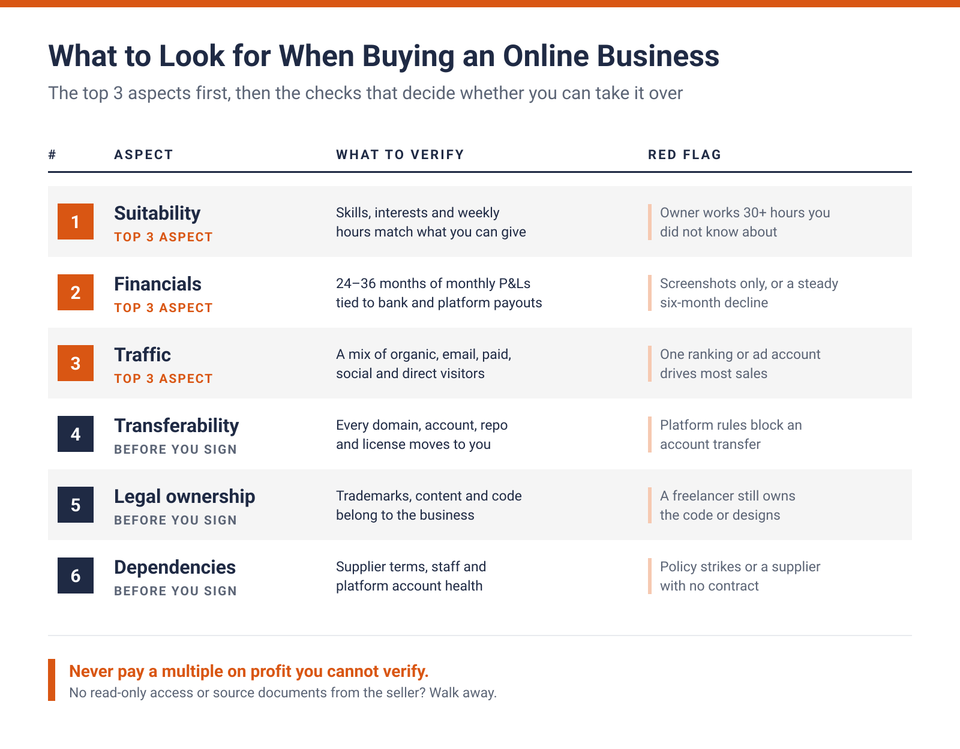
Buying an existing online business can get you revenue, customers and traffic on day one, but only if what you are buying is what the listing says it is. Before you make an offer, weigh three things above everything else: whether the business suits you, whether the financials hold up, and whether the traffic behind the sales is healthy and diversified. Get those right and the rest of due diligence becomes confirmation rather than discovery.
Key Takeaways
Fit comes first. A profitable website you have no skills, time or interest to run is a poor purchase, because most online businesses need an engaged owner to keep growing.
Ask for at least 24 months of monthly profit and loss statements and verify them against bank deposits and platform payouts, not screenshots.
Traffic quality matters as much as volume: one dominant channel, such as a single search ranking or one ad account, is a concentration risk you are paying for.
After the top three aspects, check transferability, supplier and platform dependence, and legal ownership of every asset.
A broker-represented deal gives you vetted financials and a structured process, which lowers the risk of buying blind.
Why Buying an Online Business Needs a Different Lens
When you buy a brick-and-mortar store, you can stand in the shop, count customers and inspect inventory. An online business has none of that comfort. What you are really buying is a set of digital assets (a domain, a website or app, customer lists, ad and marketplace accounts, content, software and supplier relationships) plus the cash flow those assets produce.
That makes verification the whole game. Revenue can be front-loaded with discounting, traffic can be propped up with paid ads that stop after the sale, and a store that looks automated may actually depend on 30 hours a week of the owner's time. If you are still deciding whether to buy or build, and which model suits you, start with our guide to buying an online business and choosing the right model. This article picks up from there: you have a candidate in front of you, and you need to know what to look for.
Aspect 1: Suitability, or Does This Business Fit You?
The first aspect is the one buyers skip most often. A business can be profitable on paper and still be wrong for you.
Match the business to your skills and interests
Choose something that lines up with what you already do well. A content site rewards someone who enjoys SEO and editorial work. An ecommerce business rewards someone comfortable with inventory, suppliers and customer service. A SaaS business needs someone who can manage developers, churn and product decisions. If the day-to-day work bores you, growth will stall, and the value you paid for will drift down.
Be honest about time
Sellers routinely underestimate how many hours the business takes, often because they have been doing the work so long they no longer notice it. Ask the seller to walk you through a typical week, list every recurring task and say who does it today: the owner, staff, freelancers or software. Then ask yourself whether you can absorb that workload alongside everything else in your life.
Check the support you will get
Ask how long the seller will stay on for training and handover, and get it in writing. Our list of questions sellers should expect from website buyers shows what a well-prepared seller will be ready to answer. A short, well-documented transition often matters more than a slightly lower price.
Aspect 2: The Financials, or Is the Profit Real and Repeatable?
The second aspect is where most deals are won or lost. You are paying a multiple of earnings, so every dollar of overstated profit costs you several dollars at purchase.
Ask for monthly data, not annual totals
Request at least 24 months of monthly profit and loss statements, and 36 if the business has that history. Monthly figures show what annual totals hide: seasonality, a one-off spike, or a slow decline. A business that peaks every holiday season is normal. A business whose last six months trend steadily down is a warning, unless the seller can show a clear, fixable cause.
Verify against third-party records
Never rely on screenshots or spreadsheets alone. Tie reported revenue to bank statements, payment processor reports and platform payouts (Shopify, Amazon Seller Central, Stripe, app stores), and compare profit with tax returns. Our article on what is likely to be requested during due diligence lists the documents to ask for.
Understand seller's discretionary earnings
Most small online businesses are priced on seller's discretionary earnings (SDE): net profit plus the owner's salary, personal expenses run through the business and one-off costs. Each "add-back" should be documented. If an add-back cannot be proven, treat it as a real cost.
Look at margin, refunds and concentration
Check gross margin by product or plan, refund and chargeback rates, and how much revenue comes from the top few customers or SKUs. If one customer or one product drives most of the profit, losing it after closing would change the value of what you bought.
Aspect 3: Traffic, or Where Do the Customers Come From?
Customers have to find the business before they can buy. The third aspect is the source, quality and durability of that traffic.
Review the traffic mix
A healthy business draws visitors from several channels: organic search, email, social, referral, direct and paid. The table below shows what each source tells you and what to watch for.
Traffic source
What it tells you
Red flag
Organic search
Long-term demand and content quality
Most traffic from a handful of pages or one keyword
Paid ads
Whether the offer converts profitably
Revenue collapses when ad spend is paused
Email list
Owned audience and repeat buying
Large list with low open rates or old signups
Social media
Brand reach and engagement
Followers bought in bulk or one viral spike
Marketplace (Amazon, Etsy)
Product-market fit inside a platform
Account health warnings or policy strikes
Direct and referral
Brand strength and partnerships
Referral traffic tied to a deal that ends at sale
A mix matters because if one channel weakens, the others keep the business running. If 80% of sales depend on a single Google ranking or a single ad account, you are buying that risk along with the business.
Get read-only access to analytics
Ask for read-only access to Google Analytics, Google Search Console, ad accounts and the email platform, not exported reports. Note that Google stopped processing data in Universal Analytics on July 1, 2023, so older history may sit in a separate property from current Google Analytics 4 data. Make sure the two line up with the revenue you have already verified.
Ask about growth and competition
Is there room to grow? Is a stronger competitor entering the niche? Is the business riding a trend that is fading? Look for growth levers the seller has not used, such as new channels, email automation, new products or international markets. Those are the upside you are buying, so they should be realistic, not hopeful. For stores, compare what you see with the signs of an established ecommerce business.
Beyond the Top 3: What to Check Before You Sign
Once a business passes on suitability, financials and traffic, confirm the details that decide whether you can actually take it over.
Transferability: every domain, hosting account, marketplace account, social profile, code repository and software license should transfer to you cleanly. Some platforms restrict account transfers, so confirm each one.
Supplier and vendor relationships: for physical products, confirm supplier terms, lead times and whether contracts can be assigned to a new owner.
Legal ownership: check trademarks, copyrights and that content, code and designs belong to the business, not to a freelancer.
Platform dependence: read the policies of any platform the business relies on and check its account health history.
Staff and contractors: know who does the work, how they are paid and whether they will stay.
Pending issues: ask directly about disputes, chargebacks, tax filings and compliance obligations.
How to Evaluate an Online Business Step by Step
Use this sequence to keep your review organized and avoid wasting time on deals that fail an early test:
Define your criteria. Set your budget, preferred business model, the hours you can commit and the minimum profit you need.
Screen the listing. Rule out anything that fails on suitability before you spend money on due diligence.
Request the financials. Get 24 to 36 months of monthly P&Ls and supporting bank and platform records.
Verify traffic and operations. Use read-only access to analytics and accounts, and map every weekly task.
Value the business. Compare the asking price with earnings, trend and risk. Our guide to how to value an ecommerce business explains how multiples are set.
Make an offer and sign a letter of intent. Agree on price, structure, transition support and the due diligence period.
Complete due diligence and close. Confirm every claim, then transfer assets through escrow or a structured closing.
Common Mistakes Buyers Make
Falling for a headline revenue figure while ignoring margin and owner hours.
Accepting screenshots instead of verified records.
Treating a recent revenue spike as the new normal.
Underestimating the work needed to learn the business.
Skipping a written transition and training agreement.
Assuming every account can be transferred without checking platform rules.
The single most expensive mistake is paying a multiple on profit that cannot be verified. If the seller will not provide read-only access or source documents, walk away.
Financing the Purchase
Many buyers combine their own cash with outside financing. SBA 7(a) loans can be used to buy a business, with a maximum of $5 million, and lenders typically expect the buyer to contribute part of the price as equity. Seller financing, where the seller lets you pay part of the price over time, is also common and signals that the seller has confidence in the business. Our deal financing team can explain the options for a specific deal.
Final Thoughts
The original advice still holds: suitability, financials and traffic are the three aspects to consider before purchasing a business online. What has changed is how much you can and should verify. With read-only data access, verified financials and a clear transition plan, buying an existing online business is far less of a leap of faith.
If you want to skip the guesswork, browse vetted online businesses for sale represented by Website Closers. Each listing is prepared by an experienced broker, so you start your evaluation with organized financials and a seller who is ready for due diligence.
Paul has had a successful 25 year career in corporate America, where he led and scaled large technology divisions at Fortune 1000 companies. Following these milestones, Paul spent 8 years as an entrepreneur, running, buying, and selling his own businesses.…
How do you know if an online business is worth buying?
An online business is worth buying when its profit is verified by bank and platform records, its traffic comes from several healthy channels, and it fits your skills and available time. Compare the asking price with seller's discretionary earnings, the trend of the last 24 to 36 months and the risks you find. If the numbers only work on optimistic assumptions, keep looking.
Is buying an existing online business a good idea?
It can be, because you start with revenue, customers and traffic instead of building from zero. The trade-off is price: you pay a multiple of earnings up front, so you need to verify what you are buying. Buyers who check suitability, financials and traffic carefully, and get a written handover from the seller, avoid most of the risk that comes with a purchase.
What financial records should I ask for before buying an online business?
Ask for at least 24 months of monthly profit and loss statements, plus bank statements, payment processor reports, platform payout reports and tax returns for the same period. Request documentation for every add-back used to calculate seller's discretionary earnings. Screenshots and summary spreadsheets are not enough; the figures should tie back to records the seller cannot easily edit.
What questions should I ask the seller of an online business?
Ask why they are selling, how many hours they work each week and on what, where customers come from, which suppliers and contractors the business relies on, and whether every account can be transferred. Also ask about refunds, chargebacks, disputes and platform warnings, and how long they will stay on to train you after closing.
Can I finance the purchase of an online business?
Yes. Many buyers combine their own cash with an SBA 7(a) loan, which can be used to acquire a business and goes up to $5 million, or with seller financing, where part of the price is paid over time. Lenders usually expect the buyer to put in some equity and want verified financials, so a well-documented business is easier to finance.
Expect buyers to request financials, platform payout reports, traffic data, IP records and read-only access. Here are the due diligence documents to prep.
What makes an established ecommerce business? See the 8 signs buyers verify, from clean financials to transferable operations, and how to prove them before you sell.
7 min readRead more
Want to Sell Your Business Now? Get a Free Consultation!
A broker calls you back, usually within 1–2 hours
Confidential: nothing is shared without your consent