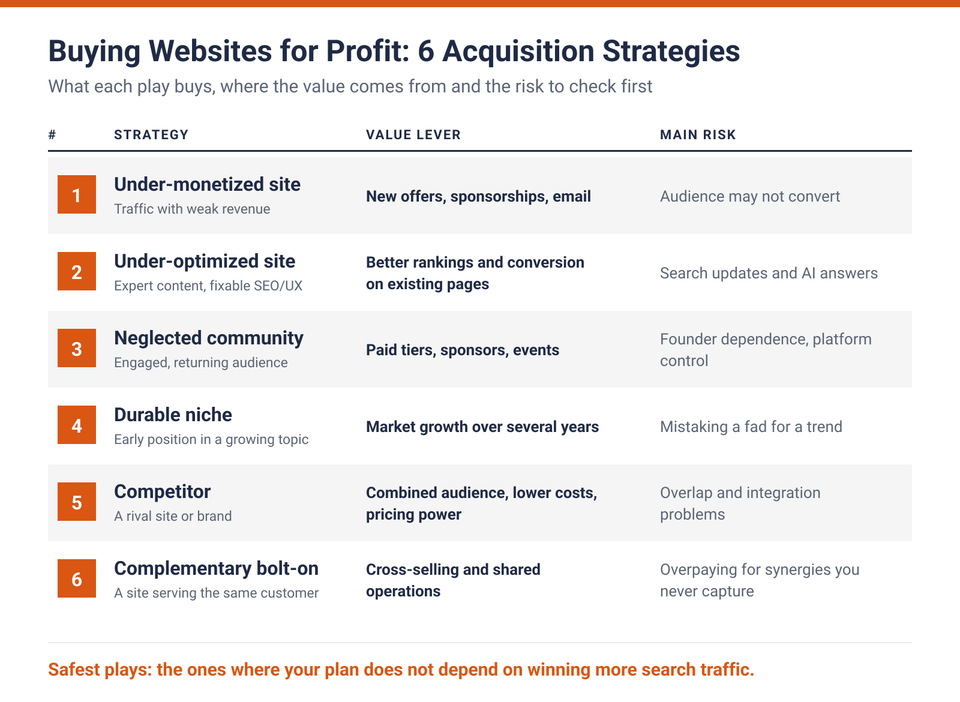
Buying websites for profit works when you buy with a clear thesis: you know exactly which gap you will close after closing, whether that is weak monetization, poor SEO, a neglected audience or a competitor you can absorb. The six website acquisition techniques below are the plays experienced internet entrepreneurs still use, updated for a search landscape shaped by AI answers, Google's spam policies and tighter buyer due diligence.
Key Takeaways
Every website acquisition needs a value-creation thesis before you look at listings. Without one, you are simply paying the seller's asking price for the seller's results.
The six repeatable strategies are: under-monetized sites, under-optimized sites, neglected communities, durable niches, competitor consolidation and complementary bolt-ons.
Buying a domain only for its old rankings is now risky. Google's expired domain abuse policy (March 2024) targets sites repurposed mainly to exploit a previous owner's reputation.
Content sites typically trade on seller's discretionary earnings (SDE) toward the lower-to-middle part of the 3x to 10x range for private internet businesses, so traffic quality and diversification decide the price.
Verify revenue, traffic and transferability yourself, and plan the first 90 days before you sign the purchase agreement.
What Is a Website Acquisition Strategy?
A website acquisition strategy is your answer to one question: why will this site be worth more in your hands than in the seller's? Brick-and-mortar buyers can see what they are getting, whether it is a warehouse, a storefront or an apartment block. Online, two sites with identical revenue can be completely different assets. One may earn from a single affiliate program on 10 pages that rank for "best of" queries. Another may have an email list, direct traffic and three income streams.
That is why serious buyers start with a thesis, not a marketplace search. If you are still deciding whether buying beats building, start with our guide to buying an online business and choosing the right model. Once you have a model in mind, the strategies below tell you what kind of site to hunt for and where the upside comes from.
6 Website Acquisition Techniques That Still Work
1. Buy an Under-Monetized Site That Already Has Real Traffic
The classic play is a site with a loyal audience and weak revenue. The owner may rely on low-paying display ads, never tested affiliate offers, or ignore sponsorships and email. Your upside comes from monetization you can add without needing more traffic.
What to look for:
Steady traffic for at least 12 months with a healthy share of direct, email and branded search visits
Revenue per 1,000 visitors well below comparable sites in the niche
Content that matches commercial intent (reviews, comparisons, how-to guides tied to products)
No dependence on one ad network or one affiliate merchant
The risk is assuming monetization is easy. If the audience is mostly casual readers from informational queries, those visitors may not convert regardless of the offer.
2. Buy a Good Site With Weak SEO or Conversion
The original version of this strategy was "restyle the content and upload more optimized pages to grow ad revenue." The idea still works, but the bar is higher. Google's March 2024 core update and spam policies were designed to reduce unoriginal, low-quality content, so publishing more pages is no longer a growth plan by itself.
The modern version looks for sites with strong subject expertise and fixable problems:
Slow pages, poor mobile experience or broken internal linking
Thin category pages and outdated articles that still attract links
Low conversion rates on pages that already get qualified traffic
Missing email capture, so visitors leave and never come back
The upside should come from improving pages that already earn trust, not from adding hundreds of new ones.
3. Buy a Community or Niche Audience the Owner Can No Longer Run
Forums, membership sites, newsletters and enthusiast communities often come up for sale when the founder burns out or can no longer cover hosting and moderation. These assets can be valuable because the audience comes back on its own.
Check three things before you buy:
Whether the community lives on a platform you will control after closing, or on a third-party platform the owner cannot transfer
Whether activity depends on one personality who is leaving
Whether member counts and engagement can be verified from the platform itself
The old advice to pick a site "with pre-established high AdSense keyword prices" has aged poorly. Ad rates change constantly, and communities rarely monetize well through display ads alone. Sponsorships, paid tiers and job boards are usually stronger levers.
4. Buy Into a Durable Niche Before It Peaks
Trend spotting can produce outsized returns, but only when the niche has lasting demand. A site built around a fad can lose most of its traffic within a year. The safer approach is to look for niches with growing but steady interest, such as long-term shifts in how people work, shop, learn or care for their health.
A practical test: check search interest over five years, not five months, and look for evidence of repeat buyers, recurring subscriptions or ongoing product categories. If the niche only makes sense during a single season or news cycle, price the site as a short-term bet.
5. Buy a Competitor to Consolidate the Market
Buying the competition can help you dominate a niche faster than organic growth. Merging two sites can combine audiences, remove duplicate costs and strengthen your position with affiliate partners, suppliers or advertisers. Some industries merge more easily than others: two content sites in the same niche can often be combined, while two brands with different customers may be worth more kept separate.
Before you bid, map the overlap:
Shared keywords and audiences (high overlap means less incremental traffic after a merge)
Supplier, merchant or platform terms that may change after an ownership transfer
Whether you will redirect the acquired site or run it as a separate brand
Consolidation is a classic reason for M&A at every size. Our overview of the top reasons for mergers and acquisitions explains how buyers think about these synergies.
6. Buy a Complementary Site (Bolt-On or Buy-and-Build)
A complementary acquisition sells to the same customers without competing head-on. An ecommerce store selling camping gear might buy a hiking content site, or a SaaS tool might buy a blog that already ranks for its users' problems. Cross-promotion through email, on-site placements and bundles can lift both properties.
This is also the logic behind a buy-and-build strategy: start with one platform business and add smaller, related sites over time, centralizing operations and marketing. It works best when you already run a business in the niche, because you know the customer and can integrate quickly.
What About Buying a Domain Name Alone?
The original advice to "buy a site strictly for its domain name and play the odds" needs a warning. .com is still the dominant extension, with 169.8 million registrations at the end of Q3 2026 out of 411.6 million domains worldwide, according to Verisign's Domain Name Industry Brief. A short, memorable .com can be a real brand asset.
Buying an expired or established domain mainly to exploit its old rankings is a different matter. Google's expired domain abuse policy describes this exact practice: purchasing an expired domain and repurposing it primarily to manipulate search rankings with content that gives users little value. If you buy a domain, buy it for the brand, not for borrowed authority.
Website Acquisition Strategies Compared
Strategy
What you buy
Where the value comes from
Main risk
Best for
Under-monetized site
Traffic with weak revenue
New offers, sponsorships, email
Audience may not convert
Marketers with monetization skills
Under-optimized site
Expert content with fixable SEO or UX
Better rankings and conversion on existing pages
Search updates and AI answers
SEO and CRO operators
Neglected community
An engaged, returning audience
Paid tiers, sponsors, events
Founder dependence, platform control
Buyers who can manage people
Durable niche
Early position in a growing topic
Market growth over several years
Mistaking a fad for a trend
Patient, research-driven buyers
Competitor
A rival site or brand
Combined audience, lower costs, pricing power
Overlap and integration problems
Owners already in the niche
Complementary bolt-on
A site serving the same customer
Cross-selling and shared operations
Overpaying for synergies you never capture
Buy-and-build investors
How AI Search and Google Updates Changed the Math
Content and affiliate sites remain popular entry points for first-time buyers, but the risks look different than they did a few years ago. A Pew Research Center study published in July 2025 found that Google users clicked a traditional search result in 8% of visits when an AI summary appeared, compared with 15% of visits when no summary appeared. For a site that lives on informational search traffic, that is a direct threat to revenue.
Valuations reflect this. FE International's 2026 analysis of website and content business multiples places most content sites, blogs and newsletters on SDE toward the lower-to-middle part of the roughly 3x to 10x range for private internet businesses. Multiples rise with owned audiences (email subscribers and brand searches), diversified monetization, traffic that has held up through recent algorithm updates and operations that run without the founder. They fall with search dependence, page concentration and reliance on a single ad network, merchant or sponsor.
For buyers, this means the safest strategies are the ones where your plan does not depend on winning more informational search traffic. Monetization, conversion, community and consolidation plays still work even if search volume stays flat. For a deeper look at how pricing works, read our guide to how website valuation works.
How to Execute a Website Acquisition, Step by Step
Write your thesis in one sentence. For example: "Buy a content site in the outdoor niche earning mostly from display ads and add an email list and affiliate partnerships."
Set your budget and financing. Decide how much cash you will commit and whether you will use seller financing or an SBA loan. Our deal financing team can explain which structures fit online businesses.
Source deals that match the thesis. Browse curated businesses for sale and tell brokers exactly what you are looking for, so they can flag matching listings early.
Verify everything in due diligence. Tie revenue to payout reports and bank statements, review analytics with direct access and confirm what transfers. Our buyer's due diligence checklist covers the full list.
Price the deal on verified earnings, adjusted for the risks you found, and structure it to protect you (escrow, a transition period and, where useful, an earn-out).
Buying on screenshots instead of verified data, especially for revenue and traffic claims
Paying for the seller's growth plan rather than the business's current, proven earnings
Ignoring concentration risk: one traffic source, one merchant, one supplier or a handful of pages earning most of the revenue
Underestimating the time needed to run the site, which is common with communities and ecommerce stores
Treating a quick flip as a low-risk strategy. If that is your goal, read our guide to navigating website flipping first
Skipping a transition period, so key knowledge leaves with the seller
The Bottom Line
Buying an existing website can be faster and more predictable than building from scratch, but only when you know which gap you are buying and how you will close it. Pick one of the six strategies, filter listings against it and verify every claim before you commit. Sites that fit categories like content websites, ecommerce businesses and SaaS businesses each carry different risks, so match the asset to your skills.
If you are ready to look at vetted opportunities, explore the current listings at Website Closers or speak with one of our brokers about the kind of website acquisition you have in mind.
Brent's professional journey is marked by over 15 years of invaluable experience as a healthcare executive, where he mastered the intricacies of managing large-scale operations. This foundational period laid the groundwork for his impressive foray into the eCommerce domain, which…
Buying a website can be a good investment when you buy verified earnings at a fair multiple and have a clear plan to add value, such as better monetization, conversion or consolidation. It is a poor investment when the price depends on the seller's projections or on informational search traffic that AI answers and Google updates can erode. Diversified, transferable income lowers the risk.
How much does it cost to buy an established website?
Prices vary with earnings, not traffic alone. Private internet businesses generally sell for roughly 3x to 10x annual earnings, and content sites, blogs and newsletters usually price on seller's discretionary earnings toward the lower-to-middle part of that range, according to FE International's 2026 analysis. Owned audiences and diversified revenue push the multiple up, while dependence on one traffic source or partner pushes it down.
Where can I buy an existing website?
You can buy existing websites through open marketplaces, curated marketplaces and brokers. Marketplaces offer more listings but leave more verification to you. Brokers such as Website Closers vet sellers, prepare financials and manage negotiation, due diligence and the transfer of assets, which matters more as deal size grows. Tell brokers your acquisition thesis so they can flag matching deals early.
What should I check before buying a website?
Verify revenue against payout reports and bank statements, review analytics with direct access, and check where traffic comes from and how concentrated it is. Confirm which assets transfer, including domains, hosting, accounts, content rights, supplier and affiliate agreements and email lists. Finally, check for search penalties, trademark issues and how much of the work depends on the current owner.
Can I buy an expired domain and keep its search rankings?
You can buy an expired domain, but buying one mainly to exploit its previous rankings is risky. Google's expired domain abuse policy, introduced in March 2024, targets expired domains repurposed primarily to manipulate search rankings with content that offers users little value. Buy a domain for its brand value and build genuinely useful content on it, rather than relying on borrowed authority.
Buying an existing online business? Check fit, verified financials and traffic first, then transferability. A practical checklist with red flags to watch.
Key Takeaways Identify undervalued digital assets with “good bones,” such as sites with high organic traffic but poor monetization or outdated designs. Implement high-impact improvements including SEO optimization, technical speed enhancements, and diversified revenue streams (ads, affiliates, and digital products). Utilize professional brokerage services to access a wider pool of vetted buyers and ensure your…
9 min readRead more
Want to Sell Your Business Now? Get a Free Consultation!
A broker calls you back, usually within 1–2 hours
Confidential: nothing is shared without your consent