Choosing an online business niche is the first decision a buyer makes, and it shapes everything after it: the price you pay, the multiple you can sell for later, and how hard you will have to work in between. The best online business niche for you sits where three things overlap: real and steady demand, a defensible position against giants like Amazon, and a fit with what you know how to run.
Key Takeaways
A niche is a specific audience with a specific problem, not just a product category. "Pet products" is a market; "orthopedic beds for large senior dogs" is a niche.
Narrow niches are easier to rank, advertise and defend, which is why focused stores and content sites often convert better than broad catalogs.
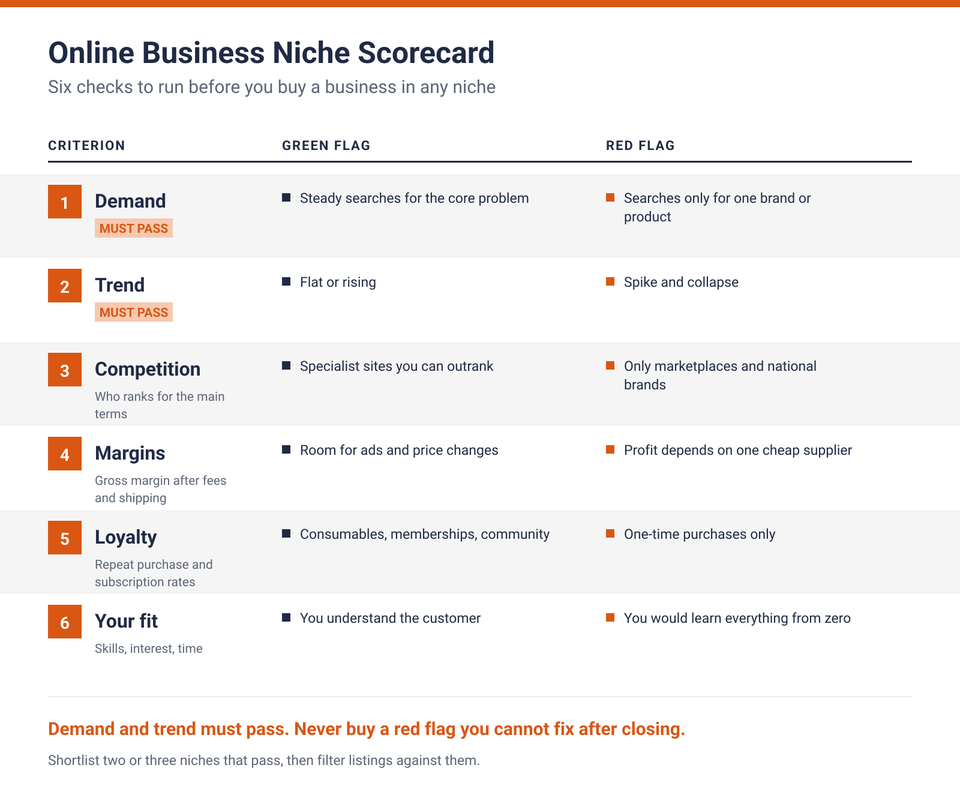
Before you buy, test the niche on six points: demand, trend direction, competition, margins, customer loyalty and your own fit.
The niche affects valuation directly. Buyers pay more for durable, diversified niches and discount fads, single-supplier products and platform-dependent models.
Shortlist two or three niches first, then filter listings, so you evaluate businesses against a plan instead of falling for one attractive listing.
What an Online Business Niche Really Is
A niche is a defined slice of a larger market, built around who the customer is and what they need. It can be defined by price point (budget vs. premium), by demographics (new parents, retirees, college athletes), by interests and values (vegan, outdoor, minimalist), or by geography. Most strong niches combine two or more of these.
Compare a few niche market examples:
Broad market
Niche
Why the niche is easier to win
Home goods
Garage storage systems for small homes
Clear problem, focused keywords, higher order values
Pet supplies
Supplements for senior dogs
Repeat purchases and loyal owners
Fitness
Kettlebell programs for people over 50
Underserved audience, strong community
Coffee
Low-acid coffee for sensitive stomachs
Specific pain point, premium pricing
Software
Scheduling tools for dental offices
Vertical SaaS with sticky subscriptions
The broad market is where Amazon and other big-box retailers already compete on price and selection. The niche is where a smaller business can become the obvious choice for a well-defined customer.
Why Niche Selection Matters When You Buy a Business
When you start a business, a bad niche costs you time. When you buy one, a bad niche costs you capital, because you pay for the earnings the niche has produced so far and then live with whether it can keep producing them.
A focused niche helps in three practical ways:
Cheaper traffic. Specific search terms are less competitive, so content ranks faster and paid ads cost less per sale.
Higher conversion. Visitors who find exactly what they were looking for buy more often than visitors browsing a general store.
Stronger defensibility. Expertise, reviews and community in a narrow space are harder for a large retailer to copy than a commodity product listing.
The niche also sets your exit. If you plan to grow the business and sell it in a few years, the next buyer will judge the same niche you are judging now. A business in a durable, growing niche keeps its value; a business riding a fad loses it when the trend fades.
If you are still deciding whether to buy at all, start with our guide to buying an online business, then come back to niche selection once the model is clear.
How to Choose a Niche Before You Buy: 7 Steps
Start with what you know. List industries, hobbies and customer types you understand. Domain knowledge shortens the learning curve after closing and helps you spot weak claims in a listing.
Check demand. Use keyword tools to see whether people actively search for the problem the niche solves. Look at the size of the core search terms and the long tail of related questions.
Look at the trend line, not a single month. Google Trends shows relative interest over five years or more. A steady or rising line is a good sign; a sharp spike followed by a decline usually signals a fad.
Map the competition. Search the main keywords and check who ranks: specialist stores and content sites you can compete with, or only national brands and marketplaces.
Run the margin math. Estimate product cost, shipping, platform fees and ad spend. On Amazon, for example, the referral fee for most categories is 15% before fulfillment and advertising costs, which squeezes thin-margin products quickly.
Judge customer loyalty. Niches with consumables, subscriptions or passionate communities produce repeat revenue. One-time purchases need constant new traffic.
Shortlist, then search listings. Pick two or three niches that pass the tests above and filter businesses for sale against them. This keeps you from buying the first listing with good numbers in a niche you would not have chosen.
Niche Scorecard: What to Check Before You Buy
Use this scorecard to compare niches, and later to compare individual businesses inside a niche.
Criterion
What to check
Green flag
Red flag
Demand
Search volume and long-tail questions
Steady searches for the core problem
Searches only for one brand or product
Trend
Five-year Google Trends line
Flat or rising
Spike and collapse
Competition
Who ranks for the main terms
Specialist sites you can outrank
Only marketplaces and national brands
Margins
Gross margin after fees and shipping
Room for ads and price changes
Profit depends on a single cheap supplier
Loyalty
Repeat purchase and subscription rates
Consumables, memberships, community
One-time purchases only
Your fit
Skills, interest, time
You understand the customer
You would need to learn everything from zero
A niche does not need to be perfect on every line. It does need to be strong on demand and trend, and it should not show a red flag you cannot fix after the purchase.
How the Niche Affects What a Business Is Worth
Valuation multiples reflect risk, and the niche is one of the biggest sources of risk a buyer looks at. FE International's 2026 market data puts typical ecommerce valuations at roughly 2.0x to 4.0x seller's discretionary earnings (SDE), with omnichannel and subscription businesses landing toward the top of that range. Where a business lands inside the range depends heavily on the niche:
Durable demand (everyday problems, consumables, professional tools) supports higher multiples than seasonal or trend-driven products.
Diversified traffic and sales channels within the niche lower risk. A store that depends on one marketplace or one search ranking is valued lower.
Brand and community add value because they are hard to copy and they carry over to the new owner.
Regulated or sensitive niches (supplements, CBD, financial products) can earn well but add compliance work in due diligence.
Chasing a fad. A product that went viral last year may have its best sales behind it. Always check the long-term trend.
Going too broad. "We sell everything for the home" competes head-on with the largest retailers in the world.
Going too narrow. A niche with a few hundred potential customers caps growth. Make sure there is room to add products or audiences.
Ignoring platform risk. A niche built entirely on one marketplace, one ad network or one supplier can change overnight.
Buying a niche you dislike. You will spend years with these customers. Low interest leads to slow decisions and stalled growth.
Turning a Good Niche Into a Good Acquisition
A strong niche is necessary but not sufficient. Once you have one, judge each business inside it on its own merits: verified financials, traffic sources, operations and how easily it transfers to you. Our checklist of the top aspects to consider before buying an online business covers that next step, and the signs of an established ecommerce business help you separate stable operations from lucky ones.
If you are building a portfolio, niche choice also shapes your acquisition strategy. Buying a competitor or a complementary site in the same niche can add value faster than starting over in a new one; see our guide to website acquisition techniques for six proven approaches.
Financing matters too. Many buyers of profitable online businesses use SBA 7(a) loans, which go up to $5 million and typically require an equity injection of at least 10%. Lenders look closely at the stability of the niche, so a durable market can make approval easier. Our deal financing team can explain the options.
Conclusion
The right online business niche gives you demand you can measure, competition you can beat and customers who come back. Settle on two or three niches before you look at listings, test each one with the scorecard above, and remember that the next buyer will judge the same niche when it is your turn to sell.
Gwen Sylvester is an experienced M&A professional who has overseen more than $200M in business acquisition transactions. Prior to her current role with Website Closers, Gwen was Senior Director of Acquisitions at Thrasio, where she closed more than 100 transactions…
How do I identify the right niche for an online business?
Start where your knowledge, steady customer demand and manageable competition overlap. List markets you understand, check search demand and a five-year trend line, see who ranks for the main keywords, and run the margin math after fees and shipping. A niche that passes on demand and trend and has no red flag you cannot fix is worth shortlisting before you look at listings.
Is it better to buy an online business in a niche or start one?
Buying gives you revenue, traffic and customers from day one and proves the niche works, but you pay a multiple of earnings up front. Starting costs less cash but takes years to validate a niche and reach profit. Many buyers choose to buy when they already know which niche they want and value time and proven cash flow over a lower entry price.
Does the niche affect what an online business is worth?
Yes. Multiples reflect risk, and the niche drives much of it. Businesses in durable niches with repeat purchases, diversified traffic and a recognizable brand usually sell toward the top of their range, while fads, single-supplier products and businesses that depend on one platform are discounted. Typical ecommerce deals fall around 2.0x to 4.0x SDE, and the niche helps decide where in that range a business lands.
What are the big 3 niches?
Marketers often call health, wealth and relationships the three evergreen niches because people spend on them in every economy. They are markets, not niches, so they are crowded at the top level. The opportunity is in specific sub-niches inside them, such as supplements for senior dogs or bookkeeping tools for contractors, where a smaller business can lead.
How can I tell if a niche is just a fad?
Look at at least five years of Google Trends data and the business's own monthly revenue. A fad shows a sharp spike followed by a steady decline; a durable niche is flat, seasonal in a repeating pattern, or rising. Also check whether demand depends on one viral product or one brand. If it does, treat recent earnings as a peak rather than a baseline.
Buying an existing online business? Check fit, verified financials and traffic first, then transferability. A practical checklist with red flags to watch.
Buying websites for profit starts with a clear thesis. Compare 6 website acquisition strategies, their value levers and risks, and how to close the deal.
9 min readRead more
Want to Sell Your Business Now? Get a Free Consultation!
A broker calls you back, usually within 1–2 hours
Confidential: nothing is shared without your consent